
AI Adoption Challenges in Saudi Arabia: What Businesses Need to Know in 2026
Saudi organizations are facing various AI adoption challenges. This guide covers the barriers, the data, and how to move forward.
Asyar-team

Saudi Arabia ranks 1st globally in public sector AI adoption. Its Cabinet declared 2026 the Year of AI. SDAIA is driving AI integration across more than 200 government entities. By almost every headline metric, the Kingdom is moving fast.
And yet, AI adoption challenges in the private sector tell a more complicated story. Over 80% of organizations in the Middle East feel pressure to adopt AI, with 69% planning increased investment, according to Deloitte.
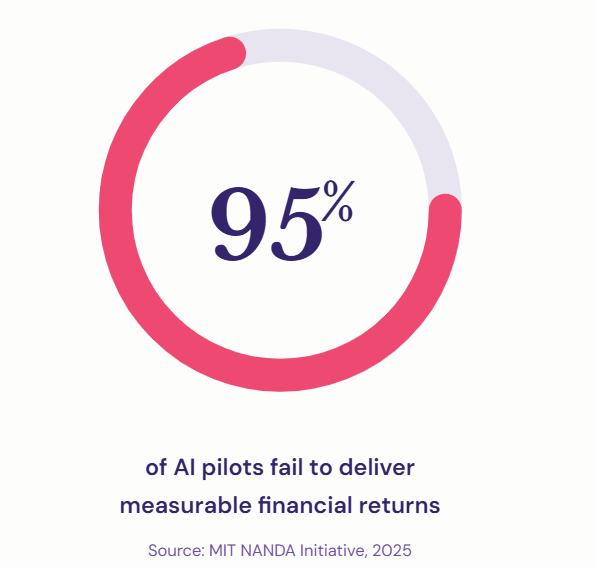
But pressure and investment alone don't produce results. Across 300 AI projects analyzed by MIT's NANDA Initiative, 95% failed to deliver measurable financial returns. This suggests that ambition isn’t the problem, it’s execution.
The challenges aren't unique to the Kingdom, but the regulatory environment, infrastructure landscape, and pace of government-led transformation create a specific set of pressures that generic AI guidance doesn't address.
So, what's really getting in the way?
In this article, we'll cover the key AI adoption challenges in Saudi Arabia in 2026, along with what it takes to move from experimentation to real results.
The Saudi Government’s Position on AI Adoption
Saudi Arabia's AI ambition is backed by policy, funding, and institutional infrastructure. In 2025, the Kingdom jumped 17 places to rank 14th in the Tortoise Intelligence Global AI Index, placing first in the Arab world and ahead of the UAE. That ranking reflects deliberate, state-level investment, not organic market momentum.
The digital foundation underpinning it is equally significant. Saudi Arabia jumped 25 places in the UN E-Government Development Index 2024, reaching 4th place globally and 1st regionally.
By the end of 2022, 98% of all public services had been digitized, and readiness for adopting emerging technologies rose from 60% in 2023 to nearly 75% in 2025.
The announcement that 2026 is the Year of AI is now driving AI integration across more than 200 government entities.
In November 2025, the Saudi Data and AI Authority (SDAIA) released its AI Adoption Framework, a mandatory governance baseline covering data governance, model accountability, transparency, human oversight, and risk management. It's also aligned to the Saudi Personal Data Protection Law (PDPL).
For organizations that work with the public sector, this framework isn't a voluntary standard.
On the infrastructure side, HUMAIN, a PIF-backed company launched in May 2025, is developing Arabic large language models (LLMs) and next-generation data center infrastructure. The aim is to address one of the structural gaps in enterprise AI deployment across the region.
The direction is clear: the Saudi government's momentum is real, accelerating, and raising the bar for private sector organizations navigating AI adoption challenges and operating in the same ecosystem.
AI Adoption vs. AI Experimentation vs. AI Implementation
Not all AI activity is equal, and the distinction matters more than most organizations think.
Before addressing what's blocking progress, let’s first clarify the different terms and stages of AI adoption. This helps you understand where your organization sits.
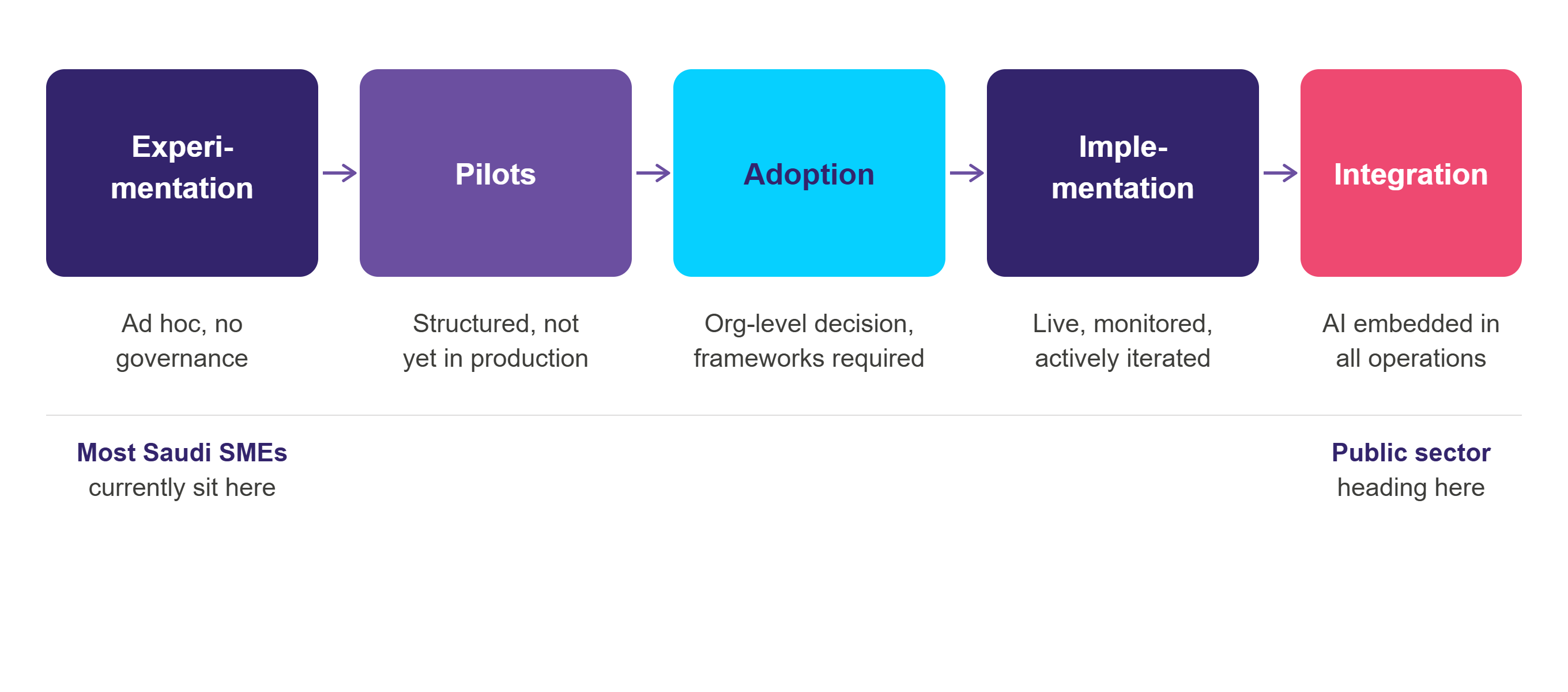
AI Experimentation is ad hoc and unstructured. Teams test tools out of curiosity or competitive pressure, with no governance, no defined metrics, and no organizational commitment. This is where most small and medium-sized businesses (SMEs) in Saudi Arabia currently sit.
AI Pilots are time-boxed and more structured, but not yet in production. This is also where most progress stalls. MIT's NANDA Initiative found that 95% of AI pilots fail to deliver measurable financial returns, with poor problem selection, data gaps, and mismanaged expectations as the primary causes.
AI Adoption is an organization-level decision to integrate AI into operations. It requires governance frameworks, infrastructure investment, and process change. This is the stage where SDAIA's AI Adoption Framework becomes a practical requirement, not a reference document.
AI Implementation means AI is live, monitored, and being actively iterated. It demands ongoing skills, model maintenance, and retraining cycles. The more advanced Saudi enterprises and much of the public sector are working at this level.
AI Integration is the end state: AI stops being a separate initiative and becomes embedded in how the organization operates, across systems, workflows, and decision-making. This is where early movers in the Saudi public sector are heading.
Where does your organization sit on this spectrum?
What Are the Most Common AI Adoption Challenges in Saudi Arabia?
Saudi organizations aren't failing at AI because the technology doesn't work. They're failing because the conditions for it to work haven't been put in place.
The MIT NANDA Initiative identified six recurring patterns across failed deployments. Each one shows up consistently in the Saudi market.
Organizational readiness
Most organizations approach AI as a technology decision. It isn't. It's an organizational one.
When companies treat AI as plug-and-play, including selecting tools before defining governance structures, success metrics, or leadership alignment, they consistently underperform compared to those that do the groundwork first.
In Saudi Arabia, this plays out across traditional enterprises and SMEs at varying levels of readiness, a recognized structural constraint in the market.
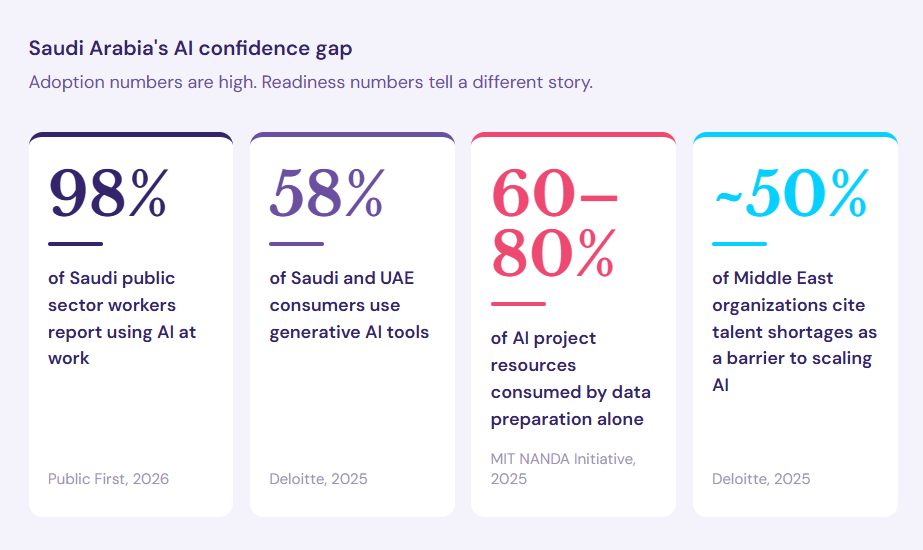
The scale of the opportunity is clear: nearly 98% of Saudi public sector workers report using AI at work, with 65% doing so at least weekly.
But high usage and organizational readiness are not the same thing. Most organizations still lack the governance structures to manage what's already being deployed.
Tip: Start with an internal audit of your governance structures, data infrastructure, and leadership alignment before selecting any technology.
Data quality and access
Poor data is the most underestimated cost in AI deployment. Across successful projects analyzed by MIT, data preparation consumed 60% to 80% of total project resources. Organizations that underestimated this faced delays or outright failure.
In Saudi Arabia and the UAE, data-related barriers are a documented drag on AI adoption across government and financial services.
Siloed data, inconsistent quality, and the absence of unified data infrastructure remain the core obstacles.
Tip: Treat data strategy as a prerequisite to AI deployment, not a parallel workstream. If your data isn't ready, your AI won't be either.
Governance and compliance
AI projects operating without governance structures consistently underperform. Cross-functional oversight covering model accountability, audit trails, and incident response is what separates deployments that scale from those that stall.
SDAIA's AI Adoption Framework and PDPL compliance are increasingly intertwined.
If you use AI in any process that touches personal data, government contracts, or public-sector workflows, governance controls are no longer optional.
Yet most organizations still lack the basic infrastructure to meet this bar: audit logs that track model decisions, data classification that identifies what AI can and can't access, and human oversight processes that define who is accountable when something goes wrong.
Tip: Map your existing PDPL compliance work to SDAIA's five governance pillars before building new frameworks from scratch. In most cases, the foundation is already there. It just needs to be formalized.
The AI talent gap
Skill gaps in AI extend beyond technical capability. Business-side understanding of AI limitations is equally critical, and most organizations underestimate it. Knowing how to run a model is different from knowing when not to, or how to interpret what it produces.
Nearly half of organizations in the Middle East cite talent shortages and insufficient capabilities as barriers to scaling AI, Deloitte reports. Limited local AI specialists continue to constrain market penetration.
Tip: Pair technical hiring with internal upskilling. A technically strong team with no business understanding of AI risk is still a governance gap.
IT infrastructure readiness
AI that performs well in a testing environment can fail completely at production scale. Poor infrastructure is a primary reason. Cloud gaps, on-premise dependencies, and integration bottlenecks all slow deployment.
In the Saudi market, high capital intensity is required to deploy secure, compliant AI at enterprise scale.
There's an additional region-specific layer. Most enterprise AI tools are built on English-language models. Arabic-first solutions are still developing, and HUMAIN's work on Arabic LLMs addresses this directly, but the gap remains a real constraint for organizations deploying customer-facing or document-heavy AI systems.
Tip: Infrastructure modernization and AI readiness are the same program. Organizations that treat them separately run into integration problems at the implementation stage.
Further reading: 14 IT Infrastructure Statistics for Saudi Arabia: Global & Regional Benchmarks
Mismanaged expectations
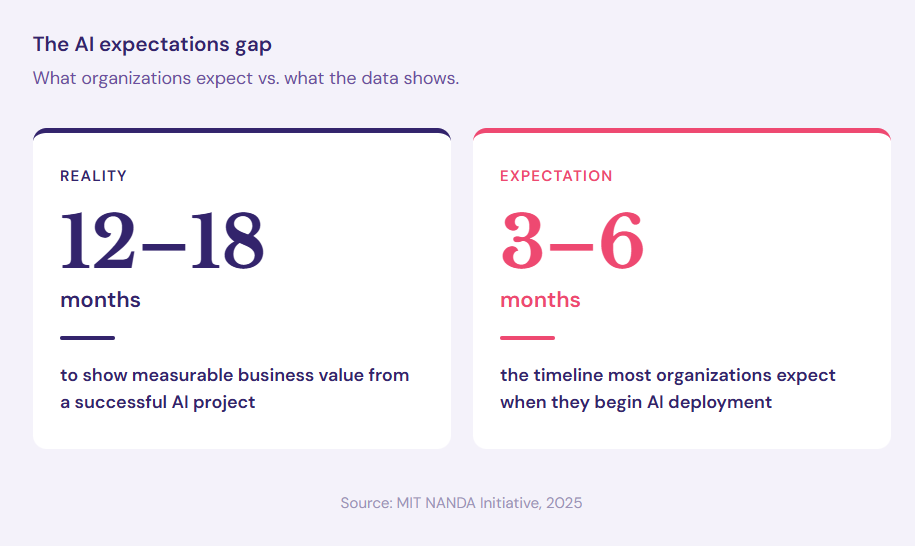
Successful AI projects took 12 to 18 months to show measurable business value, according to MIT's analysis. Meanwhile, most organizations expected results in three to six months.
This gap in expectations, not the technology, is what drives premature cancellations.
In Saudi Arabia, the pace of national-level AI ambition can compress internal timelines unrealistically.
Consumer adoption is high: 58% of Saudi and UAE consumers use generative AI tools. But consumer-level usage doesn't translate to enterprise ROI on its own timeline.
Tip: Set phased milestones tied to business outcomes, not technology deployment dates. Twelve months to measurable value is a realistic benchmark.
Further reading: How to Make a Business More Efficient: 2026 Strategies for Sustainable Growth in Saudi Arabia
How Saudi Organizations Can Move from Experimentation to Implementation
The organizations pulling ahead in Saudi Arabia share a pattern. They have confronted these AI adoption challenges differently.
They didn't start with the most sophisticated AI tools. They started with the clearest problem definition, the most prepared data infrastructure, and governance structures built before deployment, not retrofitted after.
The 2026 window matters. National AI infrastructure is being built at scale, SDAIA's framework sets a clear compliance baseline, and HUMAIN's Arabic LLM development is beginning to close the linguistic gap that has slowed enterprise deployment across the region.
The conditions for implementation are better than they have ever been. But conditions alone don't drive results.
For most Saudi organizations, the path forward starts with an honest assessment of where they actually sit on the maturity spectrum. Not where leadership believes they sit.
But where the evidence points: the state of data infrastructure, the existence or absence of governance controls, and whether AI is driven by a defined business problem or by competitive pressure to be seen doing something.
Organizations that have made this transition successfully rely on partners with local expertise. Understanding PDPL requirements, mapping to SDAIA's governance pillars, and building infrastructure that meets government procurement standards are not tasks that benefit from generic global playbooks.
Further reading: AI Enablement in Saudi Arabia: How Companies Drive Growth
You Have an AI Strategy. Do You Have the Foundations to Execute It?
Saudi Arabia has the policy environment, the infrastructure investment, and the regulatory framework. What most organizations are still building is the internal readiness to match it. In 2026, the cost of not addressing that gap is getting higher.
So where does your organization actually sit? Be honest about it. Not where you aspire to be, but where your data infrastructure, governance controls, and leadership alignment place you today.
Asyar partners with Saudi enterprises and government entities, offering AI readiness, building compliant infrastructure, and bridging the gap between experimentation and implementation.
Book a free consultation with Asyar to find out where your organization stands.