
2026 Is Saudi Arabia's Year of AI: What Does This Mean for Your Business?
Saudi Arabia has declared 2026 the Year of AI. Here's what the data says, and what it means for business and government leaders operating in the Kingdom.
Asyar-team

On 10 March 2026, the Saudi Cabinet named 2026 the 'Year of Artificial Intelligence.' The Kingdom is the first Arab country to make this declaration.
But Saudi Arabia has been making strides in AI tech, adoption, implementation, and experimentation long before this announcement.
The Kingdom ranks 14th in the 2025 Global AI Index, 3rd in the OECD AI Policy Observatory, 1st in the Arab world for advanced AI model development, and 1st globally for government AI strategy.
To anchor this milestone, the Saudi Data & AI Authority (SDAIA) launched new national guidelines designed to scale high-impact AI initiatives and cement the Kingdom's position as a global data powerhouse in line with Vision 2030.
For years, AI was a strategic objective. In 2026, it becomes a reality that every ministry, supplier, company, agency, and technology partner is now operating under.
But if you're operating in Saudi Arabia, what does the 'Year of AI' mean for your business or organization? And how does the Saudi economy benefit from this initiative?
Saudi Arabia in Numbers: AI, Tech, and Everything in Between
The potential impact of AI across the Middle East is expected to reach $320 billion, according to PwC.
Although the UAE is expected to “see the largest impact” of nearly 14% of 2030 gross domestic product (GDP), it’s the Saudi economy that’s expected to see the largest gains in 2030.
In numbers, PwC puts the Saudi figure at $135.2 billion in 2030, or 12.4% of GDP, versus $96 billion or 13.6% of GDP for the UAE.
The Saudi government has also committed $40 billion to AI investment, with forecasts that this figure will grow. At LEAP 2025 alone, the Kingdom announced investments in AI and emerging technologies exceeding $14.9 billion.
The investment reflects a broader shift in Saudi Arabia's global standing. Prior to the announcement of 2026 being the Year of Artificial Intelligence, Saudi government spending on AI and emerging technologies rose 56.25% year-on-year in 2024.
The private sector followed with Saudi AI companies securing $9.1 billion in funding across 70 investment deals. Roughly 664 companies now operate in the Kingdom's data and AI space.
Generative AI adds another layer to the economic case. A joint report by Oliver Wyman and SDAIA predicts generative AI could contribute $24 billion (SAR 90 billion) to Saudi GDP by 2030 across healthcare, financial services, industrial, and government applications.
From a labor market perspective, while 20.5% of jobs are at risk of automation, the potential for new job creation sits at 23%, with MCIT projecting a net 2.5% increase in available jobs by 2030.
The infrastructure to support this is already in place. Data center capacity grew 42.4% between 2023 and 2024. The Kingdom now hosts nine cloud regions.
Earlier in 2026, Saudi Arabia inaugurated Hexagon, the world's largest government data center, at 480 megawatts of capacity.
In May 2026, Reuters reported Saudi AI company Humain selecting Goldman Sachs to advise on a financing package to build SAR 20 billion in data centers across the kingdom.
What the Year of AI Means in Practice: The Governance Shift
Most coverage of Saudi Arabia's AI momentum focuses on the opportunity. For technology leaders inside organizations that supply or work with the public sector, the more immediate question is obligation.
In November 2025, SDAIA released the AI Adoption Framework: a mandatory governance baseline covering five pillars, namely data governance, model accountability, transparency, human oversight, and risk management.
The Year of AI declaration doesn’t introduce new requirements. It converts existing framework guidance into active audit items.
What makes this consequential is the scale of AI already embedded in Saudi government operations.
Saudi Arabia ranks 1st globally for public sector AI adoption, leading across all five dimensions of the Public Sector AI Adoption Index 2026: enthusiasm, empowerment, enablement, embedding, and education.
Nearly 98% of Saudi public sector workers reported using AI at work, with 65% saying they use it at least once per week. 89% of respondents view AI as “an empowering tool, supporting efficiency, skill development, and more advanced decision making.”
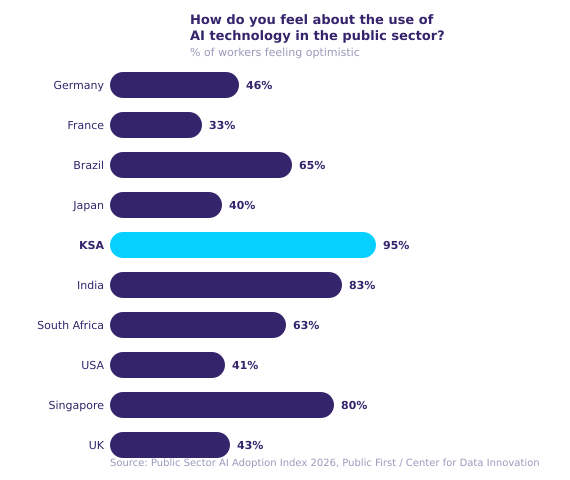
Meanwhile, in under-governed global environments, 70% of public servants use AI for work without their manager's knowledge.
The practical implications reach across sectors:
Technology companies deploying AI for government ministries now need governance built into the technical specification. Can the system log decisions? Can it explain outputs? Is there a human override in place?
Banks and insurers using AI for credit scoring, fraud detection, or customer risk profiling now face auditors who expect documented AI governance alongside financial controls
Organizations using AI for hiring or workforce planning need audit trails and human review processes in place. An AI system that screens candidates without documented oversight is a liability, not an efficiency gain.
The question isn't about whether the model works, but if the organization can demonstrate how it works, explain its decision-making process, and show what happens when it's wrong.
For organizations already navigating Saudi PDPL compliance, these obligations aren’t a separate workstream.
AI governance and data protection compliance are increasingly intertwined in how public and private sector entities evaluate their IT infrastructure and technology partners.
The infrastructure underpinning this governance environment is already in place. Shaheen III, the Middle East's most powerful supercomputer, is operational.
Construction has begun on Hexagon, the world's largest planned government data center at 480 megawatts. A National Data Lake now integrates more than 430 government systems.
Further reading: AI Enablement in Saudi Arabia: How Companies Drive Growth
By Sector: Where Is AI Creating Measurable Value?
The economic projections are compelling. But for a skeptical executive, the more useful question is: how is AI being used in Saudi Arabia right now?
Government and public sector
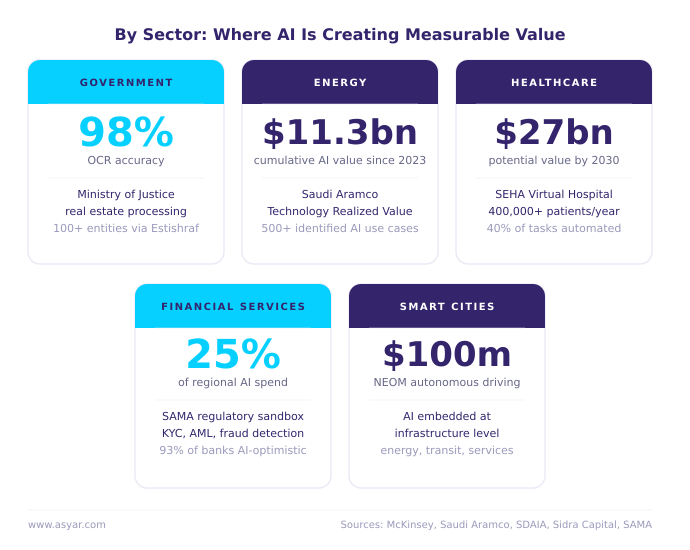
SDAIA's Estishraf Platform delivers AI-powered analytics to over 100 government entities across the Kingdom.
The Ministry of Justice processes real estate documents using optical character recognition (OCR) technology with 98% accuracy. Meanwhile, the Communications, Space, and Technology Commission (CST) uses AI to detect illegal signal boosters, improving communications performance by 49%.
These aren’t pilots. They are live deployments producing measurable outcomes inside Saudi government organizations your business might be working with.
Energy and industrial
Saudi Aramco reported a Technology Realized Value (TRV) of $5.3 billion from AI, digital, and technology solutions in its 2025 results. Key figures from that report include:
$2.6 billion attributed to AI-driven solutions across 500 identified use cases
$11.3 billion in cumulative TRV since 2023
For the world's largest oil company to report AI value at that scale, in audited financial results, is a signal that cuts through the noise of projections and pilots.
Healthcare
McKinsey estimates that AI could unlock $15 to $27 billion in economic value for the Kingdom’s health system by 2030. That’s the equivalent of 10-15% of Saudi Arabia's total projected health expenditure for that year.
AI will also automate 40% of healthcare tasks, according to the report. The infrastructure is already being built around that projection.
The SEHA Virtual Hospital, targeting over 400,000 patients annually, is one of the clearest examples of AI being deployed at clinical scale in the Kingdom.
Financial services
The Saudi financial services sector leads AI investment in the Middle East, contributing 25% of the region's total AI spend. Key applications driving that investment include:
Know Your Customer (KYC) and Anti-Money Laundering (AML) compliance
Fraud detection
Credit scoring and risk assessment
The Saudi Central Bank's (SAMA) regulatory sandbox has created a controlled environment for AI-powered fintech products to be tested and scaled, attracting both local institutions and international players.
Roughly 93% of Saudi financial institutions report strong interest in AI adoption, placing them among the highest rates globally.
Smart cities and real estate
NEOM is the most visible example, but the scope extends across Saudi Arabia's urban development agenda. AI is embedded at the infrastructure level from the start: energy management, autonomous transit, and citizen services.
The NEOM Investment Fund's $100 million investment in autonomous driving company Pony.ai is one signal of that.
Check out IT Infrastructure Conferences 2026: Global & Saudi Arabia Guide.
What Separates the Leaders from the Laggards in 2026
Roughly 81% of Saudi CEOs have already integrated gen AI into their organizations. Meanwhile, 71% expect AI to increase profitability further in the next 12 months, outpacing the global average of 49% and Middle East peers at 67%.
At the same time, two-thirds say gen AI has already boosted profitability over the past year.
So, the risk isn’t in missing the opportunity. It’s performing poorly and falling behind your competitors, who are adopting AI faster.
McKinsey's latest GCC survey puts the scaling gap in sharper contrast: 84% of organizations use AI in at least one function, up from 62% in 2023. However, only 31% have scaled it across the organization. This suggests that the issue isn’t with AI adoption, but with scaling AI.
As for ‘why,’ PwC’s 2026 Global CEO Survey indicates that “isolated, tactical AI projects often don’t deliver measurable value.” Returns come from deployment at enterprise scale, tied to business strategy.
The infrastructure bar is also rising externally. Microsoft has committed to helping 3 million Saudis develop AI skills by 2030. Meanwhile, Oracle, SAP, IBM, Google, and NVIDIA are all building Saudi-specific operations.
Organizations that delay building internal capability risk competing for talent in a market where demand is already outpacing supply.
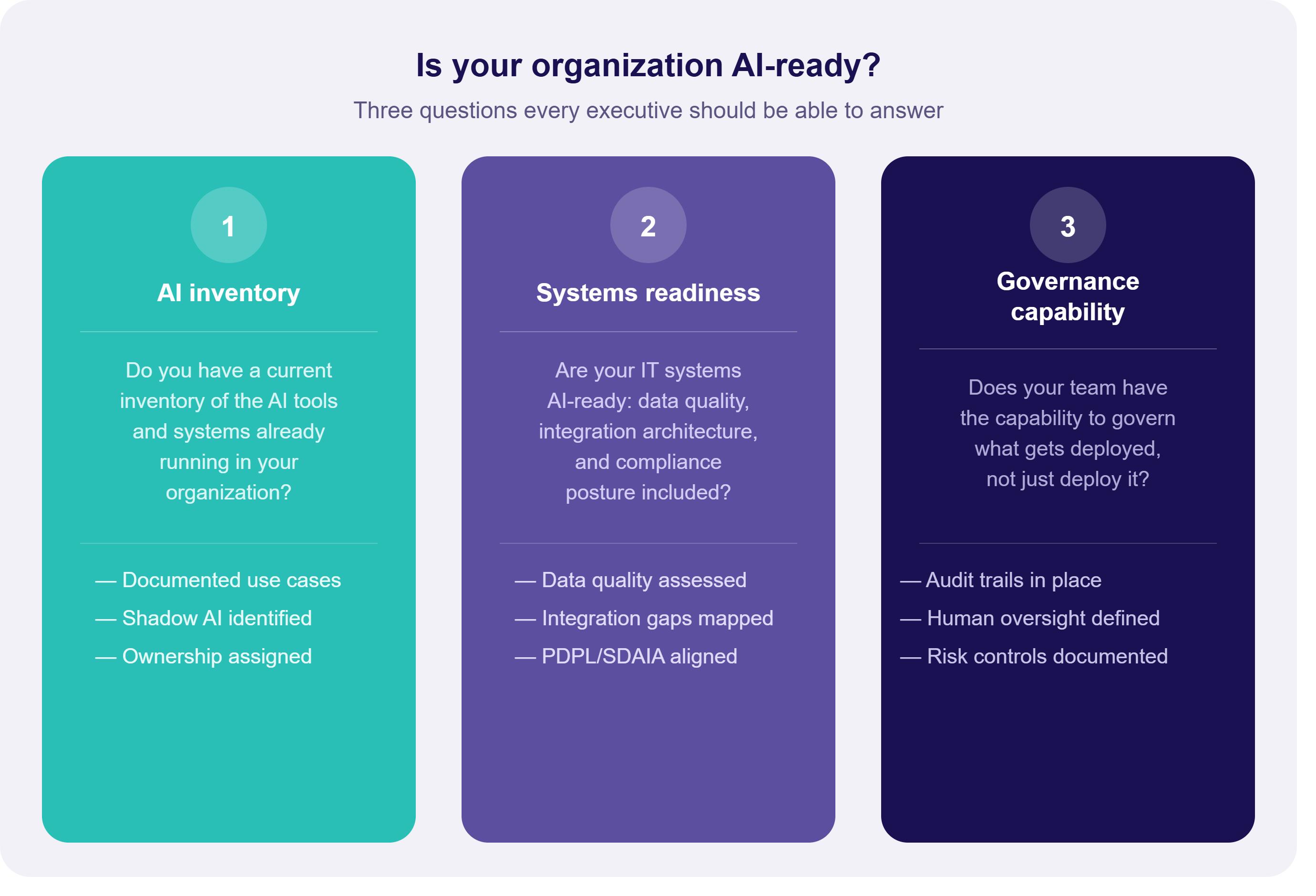
The gap between organizations generating value and those still in pilot mode comes down to three things:
Knowing what AI assets they already have in operation
Whether their IT systems can support AI at scale
Whether they have the governance governance capability to manage what gets deployed
Start with your gaps, not your ambitions
Ask yourself these questions to identify gaps in AI adoption in your organization.
Do you have a current AI tools inventory?
Are your IT systems AI-ready: data quality, integration architecture, and compliance posture included?
Does your team have the capability to govern what gets deployed, not just deploy it?
Further reading: What Does AI Enablement Mean for Saudi Businesses?
The Organizations That Move Now Will Define the Market
2026 is not a soft deadline. It’s the Year of Artificial Intelligence, which means every ministry, supplier, and technology partner in the Kingdom is operating under the same mandate. And they’re being evaluated on it.
SDAIA's framework is active. Government bodies are already operating inside AI workflows. The organizations that build the right foundations now will have a structural advantage over those that wait.
Asyar experts have spent 20 years working with Saudi public and private sector organizations, from PDPL alignment to intelligent workflow deployment, with full compliance across NCA, SAMA, and other Saudi regulatory requirements.
We help organizations translate this policy moment into outcomes that hold up in audits, procurement evaluations, and boardroom reviews.
Whether you are assessing your AI readiness or scaling an active program, our team can help you define the right path and build it.
Book your free consultation to learn more about using AI in your organization.