
31 Digital Transformation Statistics for Saudi Arabia [2026]
Saudi Arabia's digital transformation statistics in 2026: ICT market growth, AI adoption rates, cloud spending, and what they mean for your business.
Asyar-team

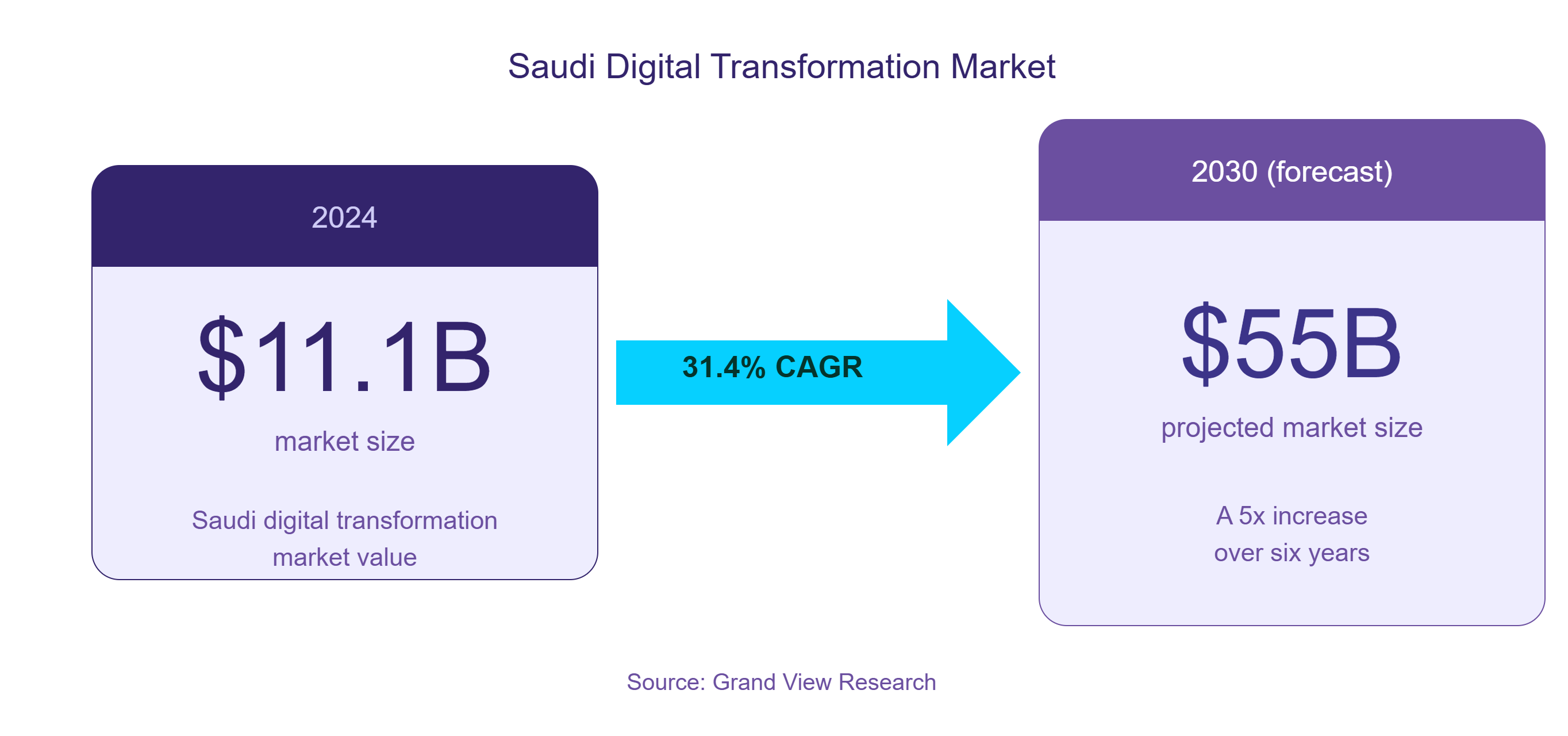
Saudi Arabia isn’t easing into digital transformation; it’s setting the regional benchmark. The Kingdom now accounts for over a third of all Middle East digital transformation spending, with the digital market projected to surge from $11.1 billion in 2024 to $55 billion by 2030, at an aggressive CAGR of 31.4%.
For business and technology leaders, that pace is a pressure test of whether your organization's infrastructure, cloud environment, and compliance are ready for what's already underway.
The question is whether your organization can keep pace.
In this article, we break down the digital transformation statistics shaping Saudi Arabia in 2026, from AI and cloud adoption to government digitization and compliance, and what they mean for your strategy.
Saudi Arabia's Digital Economy: The Macro Picture
The Saudi digital economy reached SAR 495 billion in 2025, contributing 15% of national GDP.
The country's overall ICT market hit $45.74 billion the same year and is set to reach $72.20 billion by 2034.
Investment in research and development (R&D) also supports the Kingdom’s direction, with Saudi government-backed R&D spending rising 17% year-on-year to $6 billion in 2025.
This reflects a coordinated push across government policy, sovereign wealth, and private sector investment.
How Far Has Saudi Arabia's Government Digitization Come?
Saudi Arabia's government ICT spending reflects the scale of the Kingdom's digital ambitions. The market reached SAR 180 billion in 2024 ($47.9 billion), with Saudi research firm ANB Capital expects it to grow at a CAGR of 8% to SAR 286 billion ($76.17 billion) by 2030.
Government contracts surged to SAR 38 billion ($10.12 billion) in 2024, an 18.75% increase year-on-year. Saudi Arabia also rose to sixth place globally in the UN E-Government Development Index.
Government ICT spending reached SAR 31.9 billion in 2025, across more than 6,145 contracts. Spending on AI and emerging technologies rose 20%, while cloud computing expenditure rose 42% compared to 2024.
Cumulative government digital investment stands at SAR 113 billion, with over 97% government services now digitized.
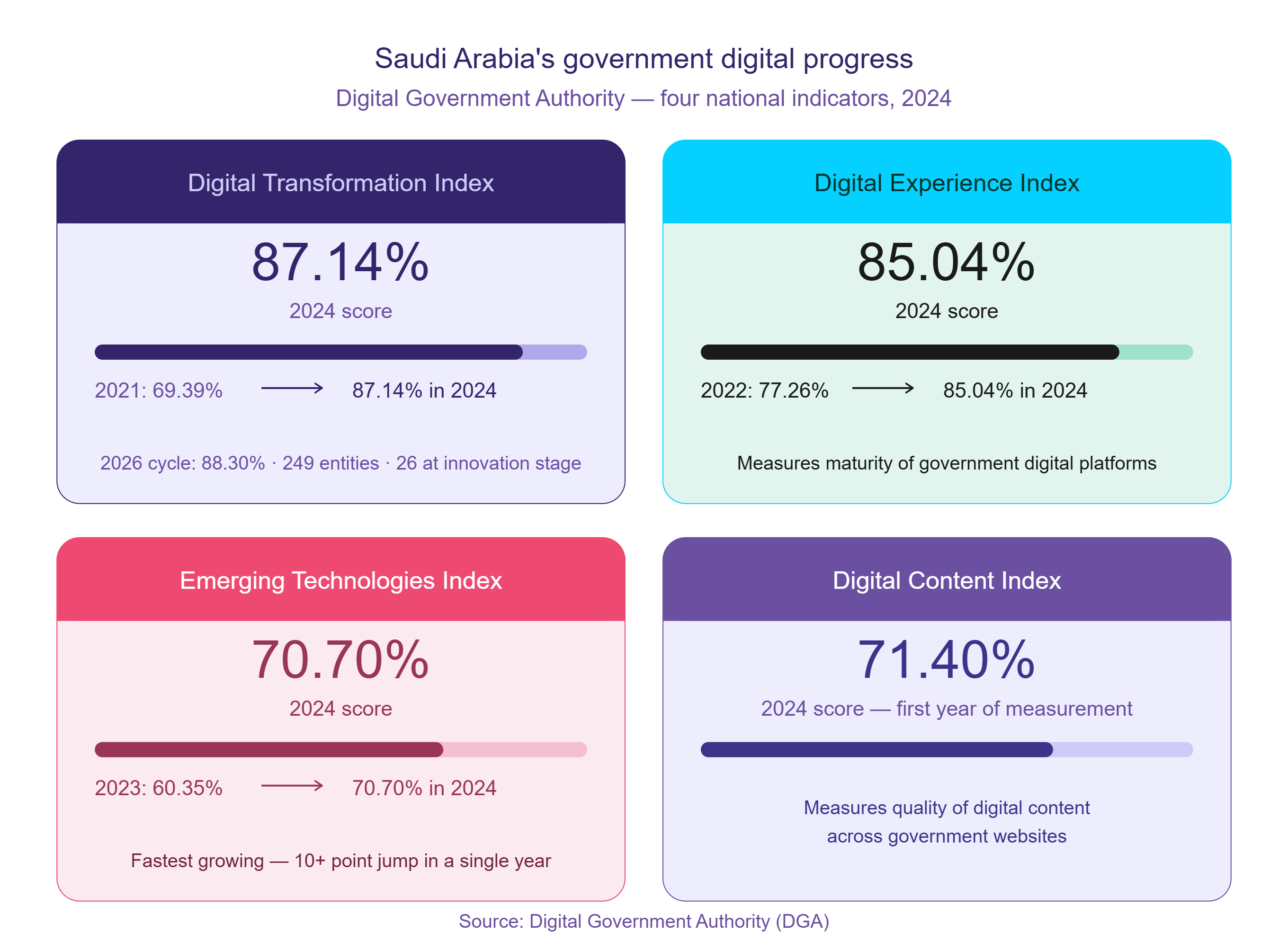
To track progress, the Digital Government Authority (DGA) measures four national indicators across government entities. As of 2024, all four are moving in the right direction:
The Digital Transformation Index measures commitment to core transformation standards. It rose from 69.39% in 2021 to 87.14% in 2024. The 2026 cycle, covering 249 government entities, recorded 88.30%, with 26 entities reaching the innovation stage.
The Digital Experience Index measures the maturity of government digital platforms and services. It increased from 77.26% at launch in 2022 to 85.04% in 2024.
The Emerging Technologies Index assesses readiness for emerging technologies. It grew from 60.35% in 2023 to 70.70% in 2024.
The Digital Content Index measures the quality and effectiveness of digital content across government websites. It recorded 71.40% in its first year of measurement in 2024.
Together, these indicators reflect a government digital system that is maturing consistently, as well as in its spending.
The Emerging Technologies Index is the one to watch. A jump from 60.35% to 70.70% in a single year suggests that post-digitalization adoption, across AI, automation, and advanced infrastructure, is moving from policy into practice across government entities.
Saudi Arabia's 2026 Digital Transformation Statistics: AI Adoption and IT Infrastructure
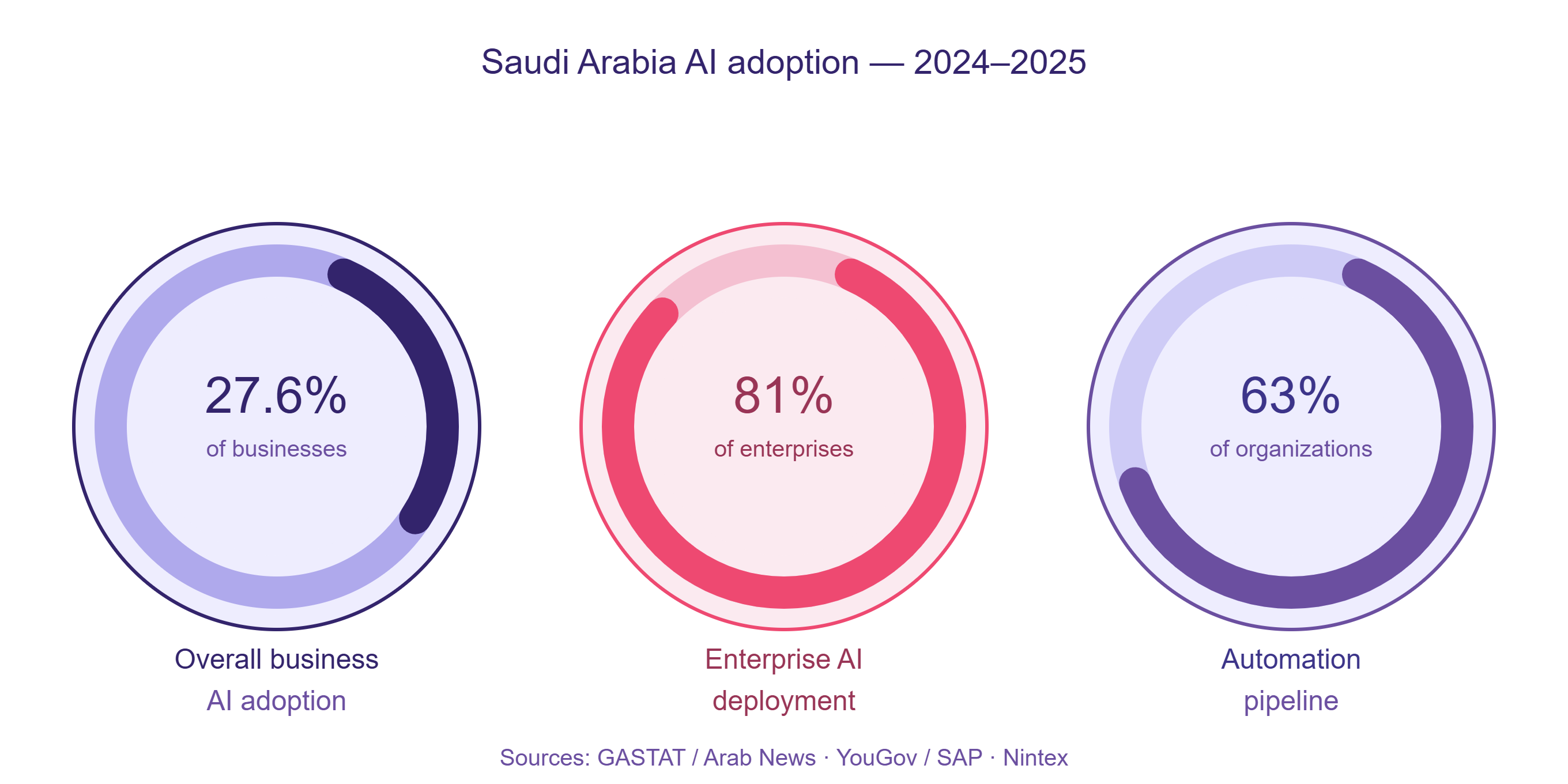
Business AI adoption reached 27.6% in 2024 in the Kingdom, with the ICT sector leading at 52.8%, followed by finance and insurance at 44.7%.
At the enterprise level, the picture looks different: 81% of Saudi enterprises are already deploying industry-specific AI solutions.
The gap between those two numbers suggests that overall AI adoption is growing steadily, while enterprise deployment is already at scale. The organizations in between, those that have started but haven't scaled, are seeing the most pressure.
Workflow automation is where that pressure is most visible. Roughly 63% of Saudi organizations plan to launch formal automation strategies within seven to 12 months. Meanwhile, 86% treat automation as a prerequisite for AI implementation.
In other words, you can't scale AI on infrastructure that wasn't built to support it.
Further reading: How Businesses Use Artificial Intelligence in Saudi Arabia
IT infrastructure investment
IT infrastructure investment reflects the same momentum. Saudi Arabia's IT infrastructure management market is projected to reach $1.8 billion by 2032, up from $690 million in 2024.
IT infrastructure statistics for Saudi Arabia show the broader IT market is set to grow by $5.6 billion between 2024 and 2029, with the infrastructure-as-a-service (IaaS) segment alone at $849.5 million and growing at a CAGR of 16.73%.
Hyperscaler foreign direct investment (FDI) in Saudi data center infrastructure has exceeded $21 billion, keeping pricing competitive and widening access across regulated industries.
According to ANB Capital, the Saudi data center market is set to reach $2.3 billion by 2029, from $1.4 billion in 2023.
Meanwhile, data center capacity is set to surge from 300 MW to 1,300 MW by 2030.
This reflects long-term confidence in the Kingdom's digital direction, raising the bar, and redefining what organizations are expected to build on.
How Fast Is Cloud Adoption Growing in Saudi Arabia?
The Kingdom’s cloud services market reached $4.77 billion in 2025 and is forecast to reach $11.47 billion by 2031, a CAGR of 15.74%.
In terms of cloud adoption, roughly 46.8% of Saudi businesses use cloud services, with large enterprises accounting for 73.65% of total cloud spending.
However, SMEs are growing fastest, at a CAGR of 16.18%, according to Mordor Intelligence. This is due to government programs expanding access across the private sector.
On deployment mix, public cloud, where computing resources are hosted and managed entirely by a third-party provider, holds 65.72% of the market.
Meanwhile, hybrid cloud, which combines private on-premises infrastructure with public cloud services, is growing at a CAGR of 16.41%.
This growth reflects organizations that need the scalability of cloud but can't move everything off-premise due to data residency requirements under PDPL and NCA frameworks.
What Do These Digital Transformation Numbers Mean for Your Organization?
These statistics point to one conclusion: digital transformation in Saudi Arabia is no longer a future priority. It's an immediate operational demand on your infrastructure, your cloud environment, and your compliance.
But the question remains: can your organization keep up?
For most enterprises, the pressure shows up in three places:
AI deployment: 81% of enterprises are already using AI, but 86% say automation has to come first. If your IT infrastructure wasn't built to support automation, that sequence breaks down before it starts.
Cloud environments: With 46.8% of businesses on the cloud and hybrid cloud growing at a CAGR of 16.41%, most organizations manage mixed environments. That creates integration demands that don't resolve on their own.
Compliance: PDPL and NCA requirements apply across all of it. For organizations measuring digital transformation ROI, compliance isn't a separate cost. It's a condition of whether the investment holds up.
The gap between organizations moving with Saudi Arabia's digital shift and those falling behind comes down to whether the underlying infrastructure can bear the load.
Competing in Saudi's Digital Economy Starts with Your Infrastructure
With 97% of government services digitized and 81% of enterprises deploying AI, the Kingdom is ensuring its operating environment matches its ambitions. This is the setting in which your organization competes today.
The gap that matters isn't between early adopters and those still considering it. It's between organizations whose IT infrastructure can support this pace of change and those that can't. AI deployment, cloud migration, and PDPL and NCA compliance all depend on a foundation that many organizations haven't fully built yet.
With 20+ years of combined experience supporting enterprise and government IT in Saudi Arabia, Asyar helps organizations build infrastructure that's PDPL- and NCA-compliant by design, scalable, and aligned with the Kingdom's digital strategy.
If your infrastructure isn't keeping pace with Saudi Arabia's digital transformation, the right time to address it is now.
Book a free consultation with Asyar to assess your IT infrastructure readiness.