
14 IT Infrastructure Statistics for Saudi Arabia: Global & Regional Benchmarks
Discover the latest IT infrastructure statistics for Saudi Arabia in 2026, from market size to government ICT spending, and GCC and MENA benchmarks.
Asyar-team

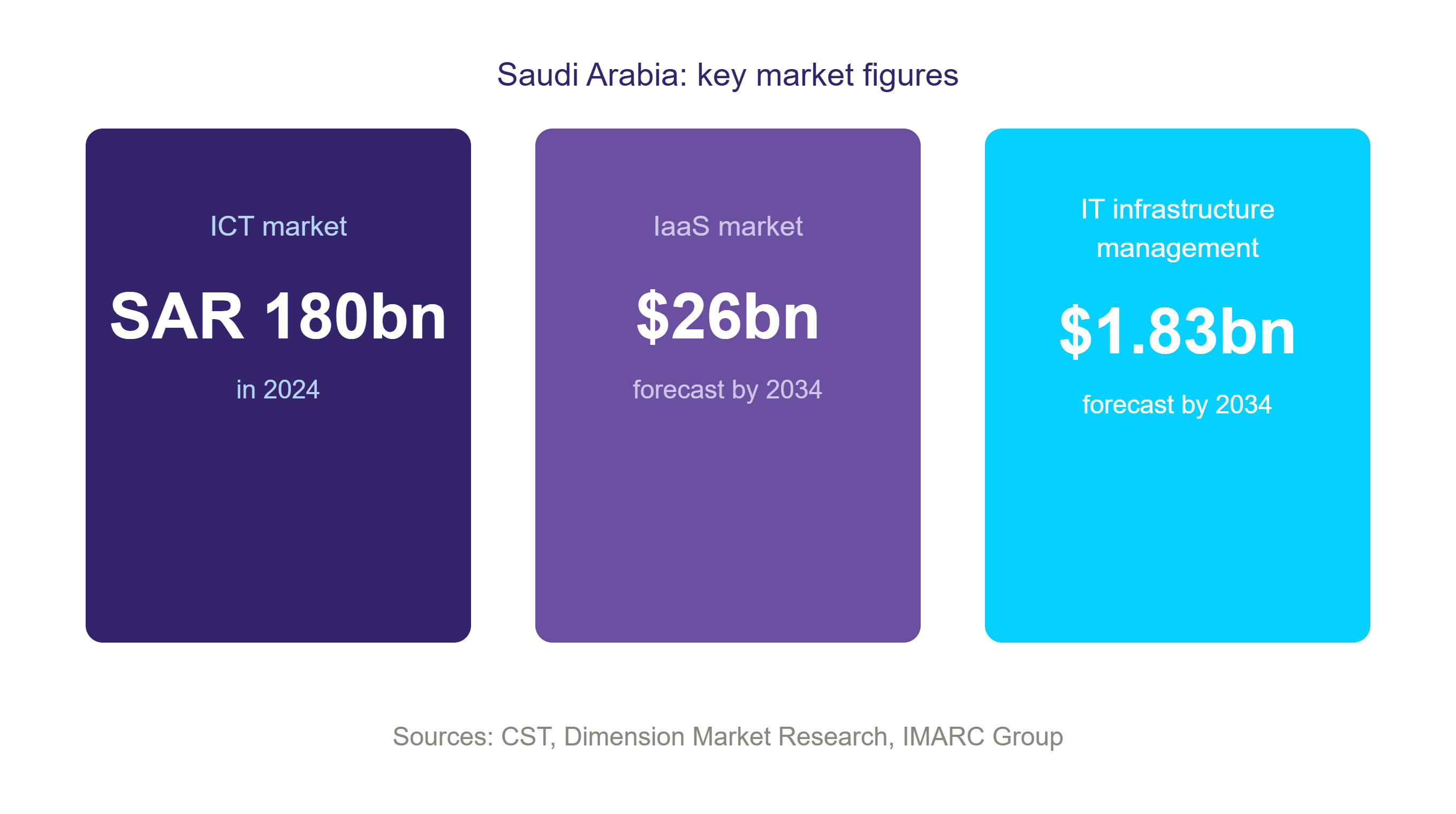
Saudi Arabia's ICT market surpassed SAR 180 billion in 2024, making it the largest and fastest-growing in the Middle East, according to the Communications, Space and Technology Commission (CST).
The same year, the Kingdom's digital economy reached SAR 495 billion. As Saudi organizations accelerate their Vision 2030 digital programs, and with 2026 declared the Year of AI, one question remains: Is the infrastructure ready?
In this article, we look at the latest IT infrastructure statistics across Saudi Arabia, the GCC, the Middle East and North Africa (MENA), and the globe.
Global IT Infrastructure Market: Setting the Benchmark
To understand the state of the Saudi IT infrastructure market and its statistics, it’s important to start with a global perspective.
Global IT infrastructure market statistics
The global IT infrastructure market is expected to reach $133 billion in 2026 and $244.77 billion by 2033, growing at a compound annual growth rate (CAGR) of 10.7%.
Meanwhile, the global data center infrastructure market was valued at $68.2 billion in 2024 and is set to reach $234.8 billion by 2034, growing at a CAGR of 13.4%.
IT Infrastructure Statistics & Investment in Saudi Arabia
Saudi Arabia's IT infrastructure market is expanding across every layer, from managed services and software to cloud infrastructure.
Here's what the numbers show.
Saudi IT infrastructure market statistics
Saudi Arabia's IT infrastructure management market reached $759.7 million in 2025. IMARC Group expects it to surge to $1.83 billion by 2034, at a CAGR of 9.99% between 2026 and 2034.
According to the research firm, growth in the Saudi IT infrastructure management market is driven by “digital transformation initiatives, government-backed technological advancements, and the rising demand for efficient data solutions.”
This growth is positioning IT infrastructure as “critical” for supporting the kingdom’s evolving digital economy.
Meanwhile, the Kingdom's system infrastructure software market generated $2.29 billion in revenue in 2024 and is expected to reach $2.92 billion by 2030. This indicates a CAGR of 4.2% between 2025 and 2030.
According to the report, data center infrastructure was the “largest revenue generating application in 2024.” Meanwhile, cloud integration is set to be the most lucrative segment with the fastest growth in the 2025-2030 period.
Saudi Arabia's Infrastructure as a Service (IaaS) market, forecast to reach $4 billion in 2025, is expected to grow to $26 billion by 2034 at a CAGR of 23.2%.
The overall Saudi IT market is forecast to grow by $6.02 billion between 2025 and 2030, at a 7% CAGR, with government digital transformation initiatives driving the bulk of that growth.
Government ICT Spending in Saudi Arabia
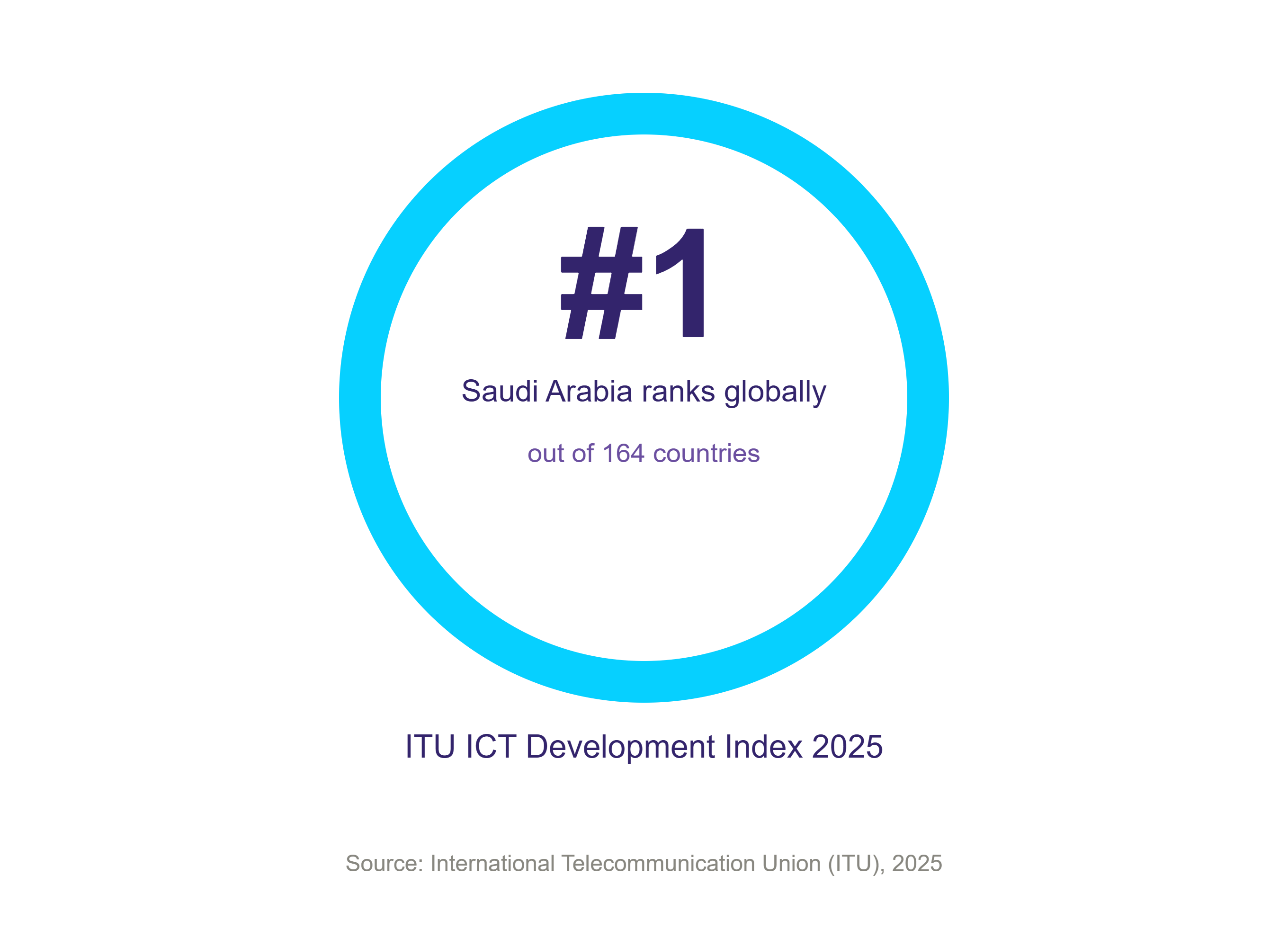
In 2025, the kingdom achieved its first global ranking in the International Telecommunication Union (ITU) ICT Development Index. The index reviews digital progress and development across 164 countries.
According to the Communications, Space and Technology Commission (CST), the kingdom boasts the “largest and fastest-growing ICT market” in the MENA region.
The Saudi ICT market was valued at SAR 180 billion ($47.97 billion) in 2024, CST reported, adding that the kingdom’s digital economy reached SAR 495 billion ($131.9 billion) that same year.
A separate report by Mordor Intelligence puts the value of the Saudi ICT sector at $65.45 billion in 2026, with forecasts to reach $101.3 billion by 2031. This marks a CAGR of 9.13% between 2025 and 2031.
In terms of investments, the kingdom invested over SAR 31.9 billion ($8.5 billion) in 2025 in ICT services, with the majority going to government contracts. The investments aim to advance digital government services.
This figure follows the completion of several major digital infrastructure projects, according to the Saudi Digital Government Authority (DGA).
In the figure above, spending on cloud computing rose by 42% compared to 2024, while spending on AI and emerging technologies grew by 20%.
Meanwhile, the U.S. State Department's 2025 Investment Climate Statement reported a 17% year-on-year increase in government-backed research and development, bringing total spending to $6 billion.
Further reading: Don’t Start Building IT Infrastructure from Scratch Until You Read This
Saudi Arabia data center market statistics
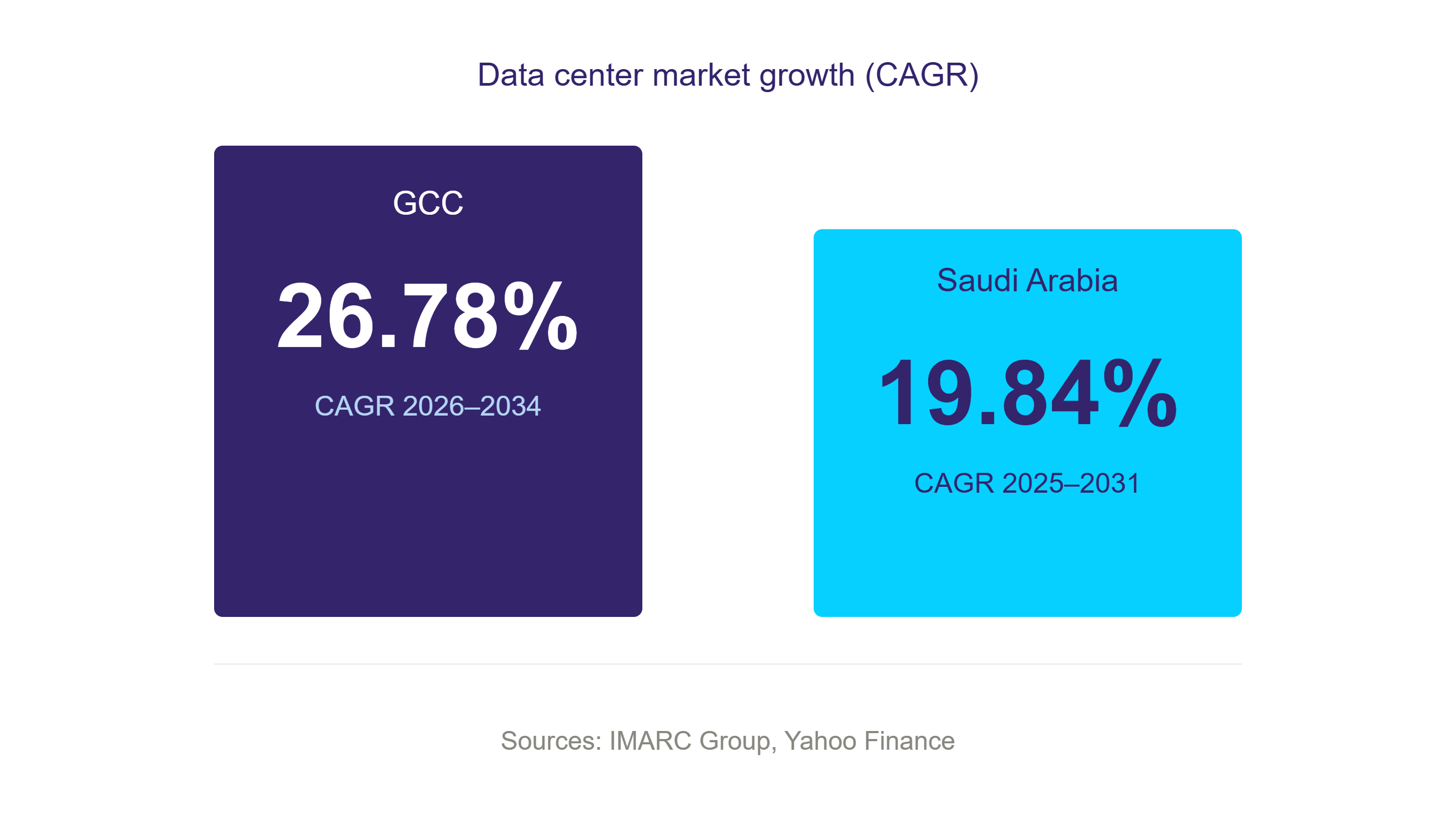
Saudi Arabia's data center market is forecast to grow from $2.08 billion in 2025 to $6.16 billion by 2031, at a CAGR of 19.84%.
The Kingdom currently operates around 40 Tier III-standard colocation facilities, with 27 more in planning or under construction.
Saudi Arabia's National Data Center Strategy targets 1.5 GW of capacity by 2030, reinforcing its position as a regional digital hub.
Further reading: AI Enablement in Saudi Arabia: How Companies Drive Growth
GCC and MENA Regional Context
The GCC infrastructure market was valued at $247.3 billion in 2025. IMARC Group expects it to reach $406.4 billion by 2034, at a CAGR of 5.09% between 2026 and 2034.
This growth is backed by rapid tech advancements, requiring updated and modern infrastructure to support new technologies, including smart cities, 5G networks, and renewable energy systems.
Saudi’s 5G infrastructure market reached $137.6 million in 2024 with forecasts to grow to $4.81 billion by 2033, marking a CAGR of 44.94%, according to IMARC.
5G, cloud, and IoT adoption are driving demand for higher-capacity networks and more sophisticated data management across the GCC. That demand is translating directly into infrastructure investment and the data center numbers reflect it.
MENA region data
Digital transformation investment across the MENA region is projected to grow from $82.6 billion in 2026 to a staggering $628.1 billion by 2036, at a CAGR of 22.5%.
The driver isn't market demand alone; it's policy. Governments across the region are converting national digital strategies into enforceable procurement, which is pulling the numbers.
Saudi Arabia's DGA sits at the center of this shift, regulating digital activities across all government agencies and setting the national standard for adoption.
Meanwhile, the UAE's National Cloud Security Policy has moved enterprise cloud migration from an IT decision to a compliance requirement. Qatar's TASMU program and Egypt's Cloud First mandate, requiring civilian agencies to prioritize cloud for all new services, follow the same pattern.
The result is a region where digital infrastructure spend is structurally embedded in government policy, not discretionary budgets.
The GCC data center market, valued at $2.39 billion in 2025, is forecast to reach $21.67 billion by 2034, marking a CAGR of 26.78% during the 2026-2034 period.
Faster cloud migration, national digitization programs, surging AI workloads, and hyperscaler initiatives are bolstering growth.
The UAE led regional demand with a 35.2% share in 2025, backed by colocation capacity expansion, sovereign cloud initiatives, and rising enterprise digital adoption across the region.
Further reading: How to Make a Business More Efficient: 2026 Strategies for Sustainable Growth in Saudi Arabia
What Do These IT Infrastructure Statistics Mean for Saudi Organizations?
The data points in one direction: IT infrastructure in Saudi Arabia is on a growth trajectory. It’s not a backend consideration, but a foundation on which Vision 2030's digital ambitions sit.
The Saudi government is playing a major role too. From billion-dollar investments in the ICT and infrastructure sectors to creating opportunities across the kingdom.
Technology providers and enterprise organizations that align their infrastructure strategies with government procurement cycles and digital transformation programs are better positioned to win contracts, build partnerships, and avoid the cost of catching up later.
Regionally, there is a sense of urgency. For example, the GCC data center market is expanding at a CAGR of 26.78%, one of the fastest buildout rates among infrastructure categories globally.
Saudi organizations that treat data center capacity, network infrastructure, and cloud readiness as long-term planning items rather than immediate priorities risk finding themselves behind a market that is moving fast.
Turning IT Infrastructure Statistics into a Digital Transformation Strategy
Saudi Arabia's IT infrastructure market is growing fast, and the data shows why. From government ICT spending to hyperscaler investment and regional data center expansion, the building blocks of a mature digital economy are being put in place.
For Saudi organizations, the practical question is where they sit within that picture. Infrastructure investment decisions made now, on data center capacity, network readiness, and cloud architecture, will shape digital transformation ROI, strategies, and outcomes for years ahead.
Organizations that wait for the market to fully mature before acting will inherit a more competitive and more expensive environment.
The statistics point to the opportunity. Translating them into a coherent infrastructure strategy is the harder part.
Asyar works with Saudi organizations to plan and implement IT infrastructure strategies that are aligned with Vision 2030 priorities and built for long-term performance.
With over 20 years of experience and full PDPL and NCA compliance, Asyar brings the local expertise that complex infrastructure decisions require.
Book a free consultation with Asyar to discuss your IT infrastructure strategy.