
Best IT Service Providers for Small Business in Saudi Arabia
Learn how IT service providers for small business help Saudi SMEs improve uptime, security, and compliance while controlling monthly IT costs.
Asyar-team

Technology now powers every aspect of small businesses in Saudi Arabia, from sales and operations to finance and team collaboration.
But as businesses grow, so do their tech challenges. Keeping systems secure, reliable, and cost-effective without the resources of a large internal IT team can quickly become overwhelming.
This is where IT service providers for small business step in. With specialized expertise and scalable support, they help businesses stay focused on growth while ensuring technology runs smoothly behind the scenes.
The right partner doesn’t just fix problems; they deliver stability, stronger security, and predictable costs. They also ensure compliance with PDPL and NCA guidance, provide Arabic-language user support, and offer in-Kingdom hosting options to meet local requirements.
And the need for that has never been greater. With 99% internet penetration and a SAR 180 billion ICT market, Saudi customers and employees expect fast, secure, always-on digital experiences.
For small businesses, that means the stakes are higher than ever when it comes to service quality and uptime. As such, in this guide, you’ll learn why IT service providers are essential for today’s small businesses in Saudi Arabia, the key features to look for, and how to choose the right partner to support your growth.
What are Managed IT Services for Small Businesses?
Managed IT services are a subscription-based model where a specialist team takes care of your company’s daily technology needs for a fixed monthly fee.
Instead of scrambling to fix problems as they arise, IT service providers for small business proactively monitor your systems, protect your data, and support your users, all while planning improvements to keep your business running smoothly.
For Saudi SMEs, this means having one accountable partner for everything from devices and cloud apps to backup and cybersecurity, rather than juggling multiple vendors or relying on an overstretched in-house team.
Here’s what’s typically included:
User help desk support for employees
Device management and maintenance
Patching, antivirus, and firewall oversight
Backup and disaster recovery
Cloud app administration
Periodic strategy sessions to plan upgrades and improvements
An added benefit? The provider documents your entire IT environment, ensuring critical knowledge doesn’t sit with just one employee, reducing risk if team members leave.
With over 1.3 million SMEs operating in Saudi Arabia, the demand for reliable, scalable IT support has never been higher. As these businesses grow, a managed IT model provides the structure and stability necessary to meet rising customer expectations and regulatory requirements, without the expense of building a full in-house IT department.

Managed IT Is the Opposite of Break/Fix
The biggest difference between managed IT and the traditional break/fix model comes down to the true cost of downtime.
Break/fix services wait for failures to occur, then charge by the hour to fix them (often at the worst possible time).
Managed IT services, on the other hand, prevent issues before they happen, align incentives around uptime, and operate on a flat monthly fee.
This means you’re paying for stability and predictable results, not just reacting to problems as they arise.
What Managed IT Services Should Include
As mentioned, the best managed IT services don’t just “keep the lights on”; they map each service to clear business outcomes and compliance needs, ensuring your technology actively supports growth and stability.
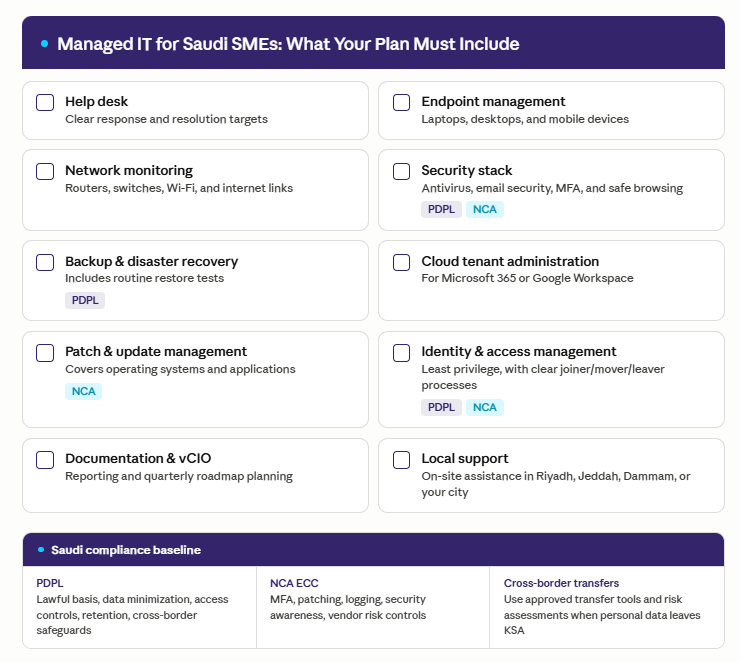
Use this checklist to evaluate IT service providers for small business and shape a plan that truly meets your requirements:
Help desk with clear response and resolution targets.
Endpoint management for laptops, desktops, and mobile devices.
Network monitoring for routers, switches, Wi-Fi, and internet connections.
Security stack with antivirus, email security, multi-factor authentication, and safe browsing controls.
Backup and disaster recovery, including routine restore testing to guarantee reliability.
Cloud tenant administration .
Patch and update management across operating systems and applications.
Identity and access management following least-privilege principles and structured joiner-mover-leaver processes.
Documentation, reporting, and quarterly roadmap planning through a vCIO (virtual Chief Information Officer) role.
Local support options for on-site assistance in cities like Riyadh, Jeddah, Dammam, or the location where your business operates.
Further reading: Don’t Start Building IT Infrastructure from Scratch Until You Read This
20 Must Know Outsourced IT Services for Small Business
Beyond the core managed services stack, many SMEs turn to IT service providers for small business to handle specialized or one-off projects. These services extend your team’s capabilities and keep your business secure, compliant, and efficient without adding permanent overhead.
Here are 20 examples to consider:
Office and branch IT setup or relocations
Cloud migrations and tenant configuration
Advanced email security and archiving solutions
Penetration testing and incident response planning
Compliance readiness for PDPL and industry-specific standards
Telephony integration with Teams or other VoIP platforms
Website hosting and hardening for stronger protection
Line-of-business application support
Data classification and retention setup
Endpoint detection and response (EDR)
Privileged access controls and auditing
Secure remote access and VPN alternatives
Backup modernization with air-gapped copies
Managed print services
Device rollout and secure disposal processes
Log centralization and monitoring
Cloud subscription cost optimization
Business continuity planning and secondary internet failover
Staff training programs on security and compliance
Fractional CIO or CTO advisory for strategic guidance
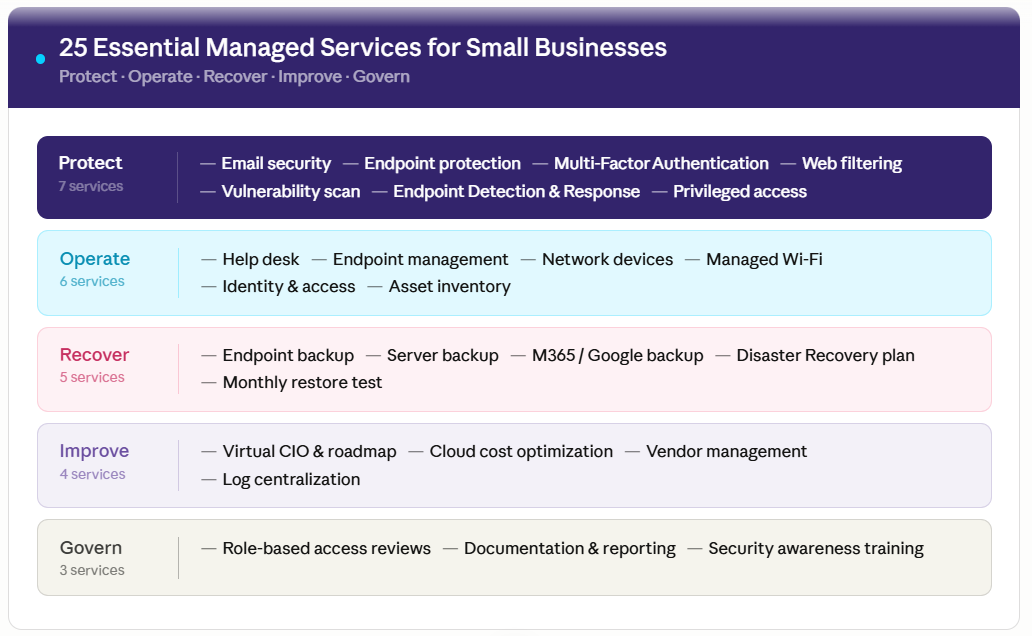
25 Essential Managed Services for Small Businesses
Here's how a complete managed IT stack breaks down across five functional categories.
Related Solutions
A managed IT strategy can be expanded with adjacent solutions that support a more resilient and secure environment:
Unified communications for seamless calling, meetings, and collaboration.
Endpoint encryption and data loss prevention to safeguard sensitive data.
Secure file transfer tools for safe sharing with partners and vendors.
Secondary internet links for failover, ensuring continuous operations during outages.
Compliance with the NCA’s e-commerce cybersecurity guidance to protect online transactions.
Is a Managed Service Provider Partnership the Right Move for You?
Deciding whether to work with IT service providers for small business comes down to whether your current IT setup is holding your business back. It’s often the right choice if any of the following are true:
You rely on a single technician or informal help, and issues keep recurring.
Leadership spends valuable time addressing IT issues instead of focusing on customers and revenue.
You need to meet PDPL obligations or align with NCA practices, but lack internal expertise.
You’re expanding operations: opening a new branch, launching e-commerce, or migrating to cloud tools.
You want predictable monthly costs instead of unpredictable repair bills.
A managed partnership replaces reaction with prevention. Instead of scrambling to fix problems after they disrupt your business, you gain access to a team with broader skills than a single hire can offer, along with clear service levels and a roadmap to guide improvements over time.
If technology slowdowns are impacting your sales, service delivery, or cash collection, a managed model often delivers more value than it costs, helping you move faster, stay secure, and scale with confidence.
The IT Team You Need to Cover Every Base
Modern IT is no longer a one-person job. To keep everything running smoothly, you need:
Support technicians for everyday user issues
Network engineers for connectivity and performance
Security analysts to protect against cyber threats
Cloud administrators for SaaS tools and identity management
A strategist to align plans and budgets with business goals
For most SMEs, hiring this entire team in-house just isn’t realistic. That’s where managed IT service providers for small business come in, giving you all these capabilities as a service, with one point of accountability.
Small Business IT Solutions
The right tools lay the foundation for stability and growth. Common solutions for Saudi SMEs include:
A cloud-based business productivity suite for email, documents, and collaboration
Managed file services with secure sharing and role-based permissions
Endpoint protection and device encryption for laptops used outside the office
Managed Wi-Fi that’s stable, secure, and scalable with guest network segmentation
Cloud backups for mailboxes, files, servers, and critical applications
Basic analytics dashboards to track sales, service, or operational metrics
Role-based access controls to ensure employees only see what they need
Secure remote access via VPN or zero-trust gateway for field teams
Your IT service providers for small business should not only select the right tools for your size and sector, but also configure them correctly, train your team, and track results so you can clearly see improvements in uptime and speed.
Small Business IT Support
Speaking of tools, strong IT isn’t solely about having the right tools; it’s also about responsive support when issues arise. Here’s what to expect:
Multiple support channels: ticket portal, phone, and remote access tools for quick fixes
Fast resolution times, with most issues solved in minutes
On-site support when needed, ideally available in Riyadh, Jeddah, Dammam, or your business location
With high mobile speeds and widespread connectivity, customers expect always-on service. Work with IT service providers for small business that align their SLAs with your operating hours and business risks.
At Asyar, we help Saudi SMEs simplify technology, reduce downtime, and stay compliant with PDPL and NCA guidance, all while keeping costs predictable. Book a free consultation to see how you can cut costs, prevent outages, and protect your business with managed services.
Proactive Approach to Managing IT for Better Results
When it comes to IT, prevention always beats reaction. Unplanned downtime doesn’t just slow your team down; it impacts sales, service delivery, and customer trust. This is where IT service providers for small business make a difference.
By taking a proactive approach through continuous monitoring, regular patching, standardized processes, and lifecycle planning, they remove common failure points before they cause disruption.
Planned upgrades also replace last-minute emergency purchases, helping you stay on budget while minimizing interruptions. The result is greater stability, higher uptime, and more time for your team to focus on customers and growth instead of firefighting IT problems.
Your Backup Method Matters
Data loss can happen at any time, whether it’s due to accidental deletion, hardware failure, or a cyberattack. Without the right backup strategy, these incidents can halt operations, damage your reputation, and impact revenue.
This is why IT service providers for small business emphasize automated, tested backups as part of a managed IT plan. They help you design a reliable recovery process that minimizes downtime and ensures compliance with local regulations.
Key elements of a strong backup approach include:
Defining recovery time (RTO) and recovery point objectives (RPO) so you know exactly how quickly you can be back online and how much data you can afford to lose.
Keeping a local fast-restore copy to quickly fix common mistakes or data loss incidents.
Maintaining a secure cloud backup for disaster scenarios like fires, floods, or ransomware attacks.
Testing restores on a regular schedule to confirm backups are reliable.
Respecting data residency and retention policies that apply in Saudi Arabia.
Using an SDAIA-recognized transfer mechanism with documented safeguards if any personal data leaves the Kingdom.
The Connection Between Managed IT and Predictable Results
Managed IT services create a structured, proactive approach to technology. By enforcing standards, such as a refresh cycle, patch policies, monitored security, and clearly defined SLAs, IT environments become far more stable.
For small businesses, this translates to:
Predictable system availability with fewer outages and disruptions.
Consistent monthly invoices, simplifying budgeting and cost control.
Easier forecasting for growth and resource planning.
Reliable performance, making it easier to meet customer expectations without last-minute IT issues.
Further reading: How to Measure Digital Transformation ROI [Guide]
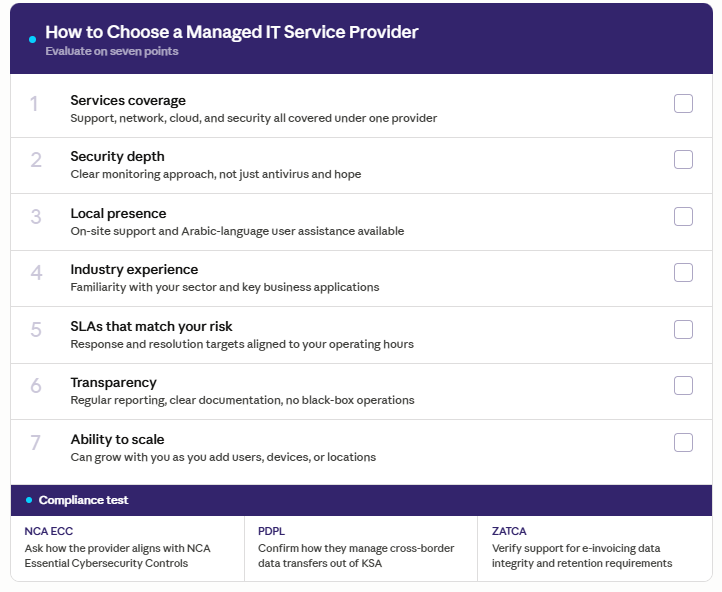
How to Choose a Managed IT Service Provider
How Much Do Managed IT Services Cost?
Pricing depends on your business size, environment complexity, and selected service levels. In most cases, you’ll pay a flat monthly fee tied to either users or devices, plus separate pricing for larger projects like office openings, migrations, or major upgrades.
The right partner will explain the pricing model in detail, ensuring you fully understand what you’re paying for and helping you maintain predictable spending.
Two Key Billing Considerations for IT Managed Services
When evaluating IT service providers for small business, your pricing model and service scope are two critical factors. The right decisions here will keep costs predictable and avoid unwelcome surprises later.
First, consider the pricing model:
Per-user: Best when each employee uses multiple devices. It's straightforward and easy to manage
Per-device: Works well for environments with shared machines, like retail or manufacturing floors
Tiered packages: Offer flexibility by combining different levels of support based on your team's needs
Second, define inclusions and extras upfront. Confirm exactly what your monthly fee covers and what counts as a separate project. Be clear on:
On-site visits and travel charges
After-hours or emergency support
Third-party software licensing costs
This prevents unexpected charges and keeps both sides aligned.
Estimate Your Managed Services Costs
To forecast costs accurately:
Count your users and devices.
Match them to the right service tier.
Include one-time fees for onboarding or cleanup services if needed.
Add a modest allowance for hardware refreshes over the next 12–24 months.
An estimator or pricing visual can help you compare multiple providers on equal terms, giving you a clear picture before committing.
Your Role in the Relationship with a Managed IT Service Provider
A successful partnership with an IT service provider for small business is a two-way street.
Here’s how to make it work:
Set clear goals and constraints from the start, so your provider understands priorities.
Approve standards and policies to guide daily operations and compliance.
Champion security and acceptable use across your team to reduce risk.
Provide early notice about new hires, new systems, or office moves to prevent surprises.
Consistently use the ticketing system to keep track of issues and ensure nothing falls through the cracks.
Review reports and roadmaps quarterly to stay aligned on progress and evolving needs.
By staying actively involved, you turn your provider into a true strategic partner, not just a vendor fixing issues.
Forget an Overhaul, Create an “IT Blueprint”
As a small business, you don’t always need to rip and replace your entire IT environment. Instead, work with your IT service provider for small business to design a blueprint with clearly defined phases.
Start by stabilizing your environment:
Fix backups and test restores regularly.
Patch systems and applications.
Secure access with strong authentication and permissions.
Once stability is in place, move to improving collaboration through better tools and workflows. Finally, modernize and automate processes where there’s a clear return on investment.
Each phase should be tied to specific business outcomes and budgets, so every action directly supports organizational goals. Review progress quarterly with your provider and adjust your blueprint as those goals evolve.
Procuring the Right Managed IT Partner
Once you’ve chosen your IT service provider for small business, take these steps to start strong:
Review the contract carefully, ensuring services, SLAs, and pricing are listed in plain, clear language.
Plan the onboarding process, with defined timelines and responsibilities on both sides.
Train your staff on new support procedures to smooth the transition.
Maintain ownership of critical assets such as domains, licenses, and admin credentials, while giving the provider the access they need to manage systems effectively.
Schedule quarterly review meetings to track success using measurable metrics like uptime, response times, closed tickets, and employee feedback. This ensures accountability and helps refine your IT roadmap over time.
FAQs: IT Service Providers for Small Business in Saudi Arabia
What should a standard managed IT package include?
A strong package should cover all the essentials for stability and security. This includes help desk support, endpoint and network management, a complete security stack, backups with regular test restores, cloud tenant administration, patch and update management, documentation and reporting, and strategic planning through a vCIO role.
Do I need in-Kingdom hosting for compliance?
It depends on data types and risk levels. Under PDPL, cross-border transfers are allowed as long as proper safeguards are in place. However, many Saudi SMEs prefer in-Kingdom hosting for backups and core workloads to simplify compliance and reduce regulatory risk.
How do e-invoicing rules affect my IT scope?
ZATCA Phase Two introduces requirements for integration and integrity controls. Your IT service provider should secure invoicing systems, manage data retention policies, and ensure that invoices are protected both in transit and at rest. This will help your organization stay compliant while safeguarding sensitive financial information.
How many providers should I evaluate?
It’s best to shortlist two or three IT service providers for small business. When comparing them, ask for a sample report and invoice, review their service level agreements (SLAs), and verify that they align with both NCA and PDPL guidelines. This process ensures you select a reliable and compliant partner.
Secure Compliance and Predictable IT Costs
Now is the time to turn all the guidance in this post into reality by choosing among the available IT service providers for small business who truly understand Saudi regulations and business needs, like us at Asyar.
With our expertise in designing and operating IT environments that align with PDPL, NCA, and SAMA expectations, you gain peace of mind knowing your IT is built for growth, compliance, and reliability. Book your free consultation.