
How to Choose IT Infrastructure for Your Business in Saudi Arabia
Choosing the right IT infrastructure in Saudi Arabia means balancing scalability, compliance, and cost. Here’s what decision-makers need to consider before investing.
Asyar-team

Saudi Arabia's IT infrastructure market is set to grow from $9.3 billion in 2024 to $30.2 billion by 2030, a 14% CAGR. The IT infrastructure management market is set to reach $1.83 billion by 2034, according to our Saudi IT infrastructure statistics.
That level of investment reflects how central these decisions have become across every sector.
But not every organization is moving at the same pace. Knowing how to choose IT infrastructure for your business is a question with real consequences.
Without a clear decision framework, you can end up with systems that don't scale, don't meet local compliance requirements, and can't support the digital workflows you're being asked to run.
In this article, we'll walk you through the key factors Saudi businesses need to consider before choosing IT infrastructure.
Why the Infrastructure Decision Matters More in Saudi Arabia
Saudi Arabia ranked first globally in the 2025 ITU ICT Development Index, reflecting years of sustained investment in connectivity and digital infrastructure.
For organizations operating here, this ranking raises the bar. Infrastructure decisions carry more weight in a market moving this fast.
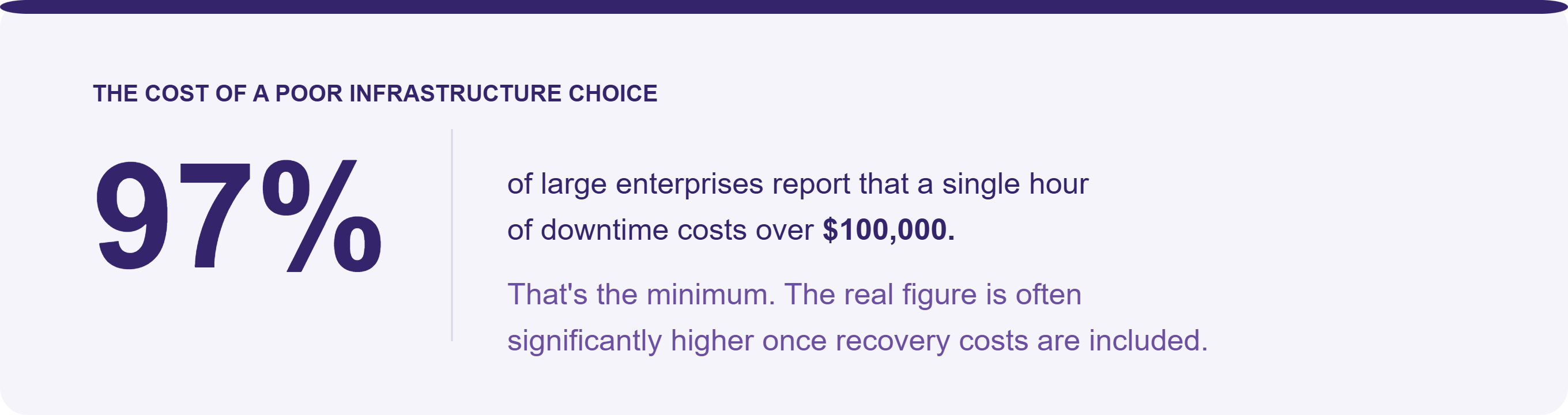
A poor infrastructure choice has a measurable cost. 97% of large enterprises say a single hour of downtime costs over $100,000.
For many, especially large businesses and those in industries like banking, government, and healthcare, the losses are much higher.
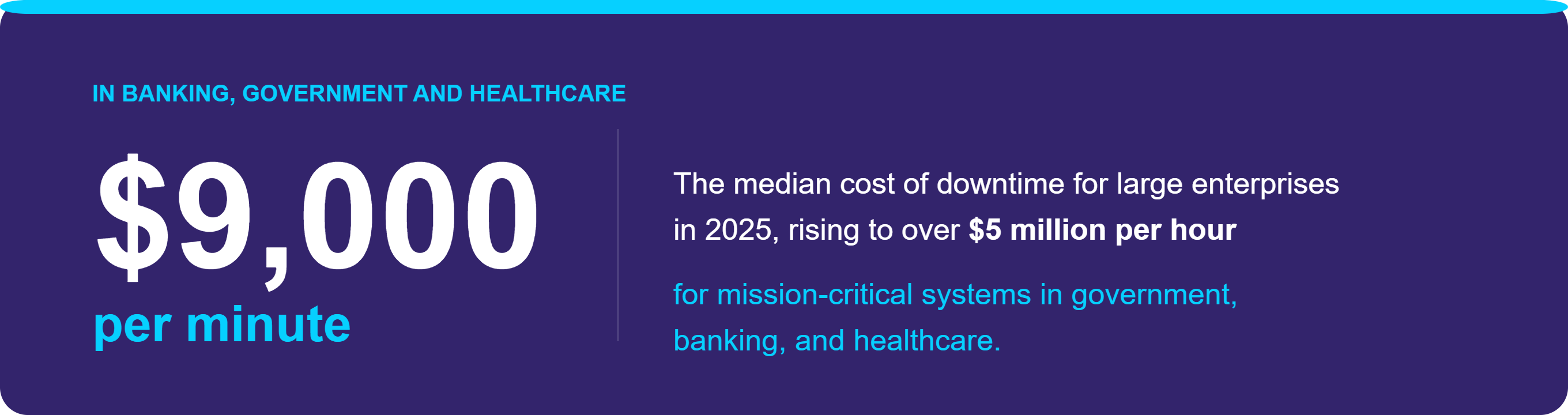
The median cost reached $9,000 per minute in 2025, rising to over $5 million per hour in banking, government, and healthcare.
Compliance adds another layer of exposure. The Personal Data Protection Law (PDPL) has been fully enforceable since September 2024, and the National Cybersecurity Authority’s (NCA) Essential Cybersecurity Controls have since been updated to cover 114 controls across five domains.
Organizations that choose infrastructure without mapping to these requirements face technical and regulatory gaps.
What Does IT Infrastructure in Saudi Arabia Cover?
IT infrastructure refers to the hardware, software, networking systems, data storage, and security layers that underpin an organization's digital operations.
In practice, the choices you make here shape more than your internal systems. They determine how quickly you recover from a systems failure, whether your data storage meets PDPL requirements, and how effectively you can deploy AI and automation across the business.
For Saudi businesses and enterprises as well as government entities, the infrastructure decision also sets the boundaries of what you can build next.
Choosing the right IT infrastructure gives you a platform that can grow, stay compliant, and recover fast. The wrong one quietly limits every decision and step that follows.
How to Choose IT Infrastructure: 5 Factors to Evaluate
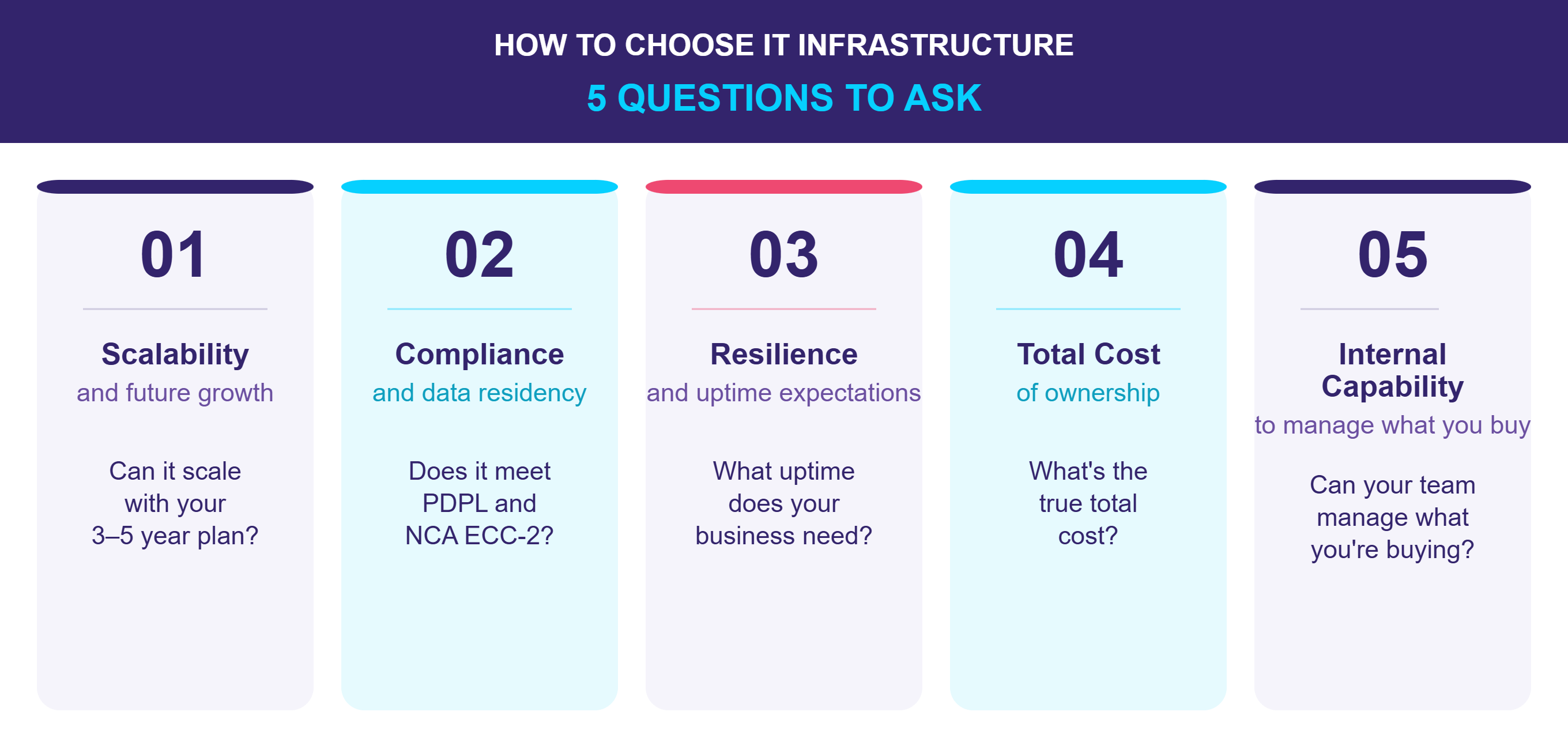
Knowing how to choose IT infrastructure starts with asking the right questions before you evaluate a solution.
These five factors cover the decisions that will shape your choice, costs, and compliance position.
1. Scalability requirements and future growth
Infrastructure that can't scale becomes a cost constraint fast. For organizations growing headcount, expanding locations, or increasing AI-driven workloads, systems that meet today's needs may not meet next year's.
Before committing to a model, map your growth scenarios over a three-to-five-year period.
Saudi Arabia's IT infrastructure market is growing at 14% annually, and the organizations driving that growth are building for where they're going, not where they are now.
On-premises and cloud IT infrastructure scale, but on different terms. Understanding how each model scales helps you choose the right fit, or whether a combination of both makes more sense for your business.
On-premises growth requires planned capital investment ahead of demand
Cloud scales on demand but needs disciplined cost governance to avoid budget creep
Hybrid approaches are increasingly common among Saudi enterprises balancing data sovereignty with operational flexibility
2. Compliance and data residency needs
Compliance requirements in Saudi Arabia affect how you handle data and which IT infrastructure options are available to you.
The PDPL sets mandatory requirements for how personal data is collected, stored, processed, and transferred.
The NCA's Essential Cybersecurity Controls (ECC-2), updated in 2024, extended that scope further, adding Saudization requirements for cybersecurity roles and enhanced controls across governance, asset management, and technology protection.
Both frameworks have direct implications for where your data lives and who can access it. Cloud infrastructure is viable under both, but data residency has to be confirmed before you commit to a provider.
For organizations working across multiple frameworks, such as SAMA and the NCA, your IT infrastructure needs to make it straightforward to demonstrate compliance with all of them.
3. Resilience and uptime expectations
Resilience requirements should drive your IT infrastructure decisions, not the other way around.
99.9% uptime allows 8.76 hours of downtime per year. 99.999% allows under six minutes. For mission-critical systems in government, banking, or healthcare, that gap separates a manageable incident from a regulatory one.
IT infrastructure monitoring is as important as the infrastructure itself. Without it, teams find out about failures when users do. Before finalizing any decision, evaluate:
Failover capabilities
Redundancy models
Documented recovery time objectives (RTOs)
4. Total cost of ownership and operational flexibility
Evaluate IT infrastructure on total cost of ownership, not upfront capital.
On-premise environments involve ongoing costs that are easy to underestimate: energy, cooling, staffing, and maintenance can represent 5 to 10% of the total IT budget.
Cloud infrastructure shifts costs from a capital expense to an operating expense, which suits organizations with variable workloads.
Hybrid models distribute cost and risk across both, but add monitoring complexity that needs to be factored in from the start.
Also consider what's often overlooked: local vendor support availability, response time guarantees, and whether service level agreements reflect Saudi market requirements or generic global terms.
5. Internal capability to manage what you buy
The right IT infrastructure in the wrong hands creates risk, not stability. Saudi Arabia's ICT talent market is growing, but a skills gap remains a recognized challenge across the sector.
Before committing, assess honestly:
Does your team have experience managing this model?
Do you have capacity for ongoing IT infrastructure monitoring?
What happens when something fails outside business hours?
For organizations without deep internal capability, managed infrastructure services shift operational responsibility to a specialist provider, while keeping governance and visibility in-house.
Further reading: What Is IT Infrastructure for a Company in Saudi Arabia?
The Four IT Infrastructure Mistakes Saudi Organizations Make
Choosing IT infrastructure is one decision. Making it work is another. These four patterns come up consistently when infrastructure investments fall short.
Buying for current needs rather than a three-year projection: Infrastructure that can't scale stops being an asset and starts being a constraint, often faster than expected.
Treating compliance as a late-stage consideration: PDPL and NCA ECC-2 both affect architecture, not just policy. Building compliance in from the start costs less, and causes fewer disruptions, than addressing it at procurement or audit time.
Underestimating the operational complexity of cloud infrastructure: Cloud reduces certain burdens but introduces others. Without the monitoring, governance, and internal skills to run it, your company won’t realize the efficiency gains.
Making choices based on vendor relationships rather than requirements: Every vendor will present their solution as the right fit. Without a clear brief built around your scalability, compliance, resilience, and cost requirements, it's difficult to evaluate whether it actually is.
Make the Right IT Infrastructure Decision
The factors covered in this article won't make the decision for you, but they'll make sure you're asking the right questions before you commit.
The right IT infrastructure scales with your business, holds up under regulatory scrutiny, and gives your teams the resilience they need to operate without interruption.
In Saudi Arabia, the stakes are higher than in most markets. The compliance environment has tightened significantly since 2024, and Vision 2030 continues to raise expectations for what organizations are required to deliver digitally.
Asyar works with enterprises and government entities across Saudi Arabia to design, implement, and manage IT infrastructure.
With 20+ years of combined experience and 100% PDPL and NCA compliance across every engagement, Asyar helps organizations make infrastructure decisions with confidence.
Ready to assess your current IT infrastructure and identify what needs to change? Book a free consultation with Asyar.