
How Is Workflow Automation Changing the Way Saudi Businesses Operate?
How is workflow automation impacting businesses across Saudi Arabia? See what it delivers and how to identify where your organization should start.
Asyar-team

Across Saudi Arabia, manual workflows and fragmented approval chains are creating an invisible tax on business growth. They raise operational costs by up to 30% and leave almost 90% of executives struggling with decision-making bottlenecks.
To eliminate this friction, organizations are turning to workflow orchestration at scale, propelling the Kingdom’s domestic market toward $4.14 billion by 2028 at a 25% CAGR.
But automation cannot succeed in a silo. Treating it as a standalone IT project rather than building the underlying IT infrastructure that can support automation, simply accelerates existing bottlenecks rather than solving them.
In this article, we'll explore what workflow automation looks like in practice, where it delivers the highest ROI for Saudi enterprises, and the operational hurdles organizations must overcome to scale effectively.
What Is Workflow Automation?
Workflow automation is using technology to automate recurring, rule-based processes with minimal human input.
Data moves, tasks are routed, and approvals are triggered without someone manually pushing them along at each step.
There are three main workflow automation approaches:
Basic automation: This involves rule-triggered routing and notifications. For example, a client submits a form, which triggers an alert, and your tech support team is assigned a task.
Robotic Process Automation (RPA): This is where software bots replicate the repetitive human actions across systems. Common actions include extracting data, entering records, or processing transactions.
Intelligent automation: This approach combines RPA with AI, enabling systems to handle unstructured data and support decision-making, not just execute fixed rules.
Most organizations don't start at a sophisticated level. Instead, they begin with a clearly defined process or visible bottleneck and a tool.
It’s worth mentioning that the Saudi RPA market is projected to surge to $1.13 billion by 2034, a 42% CAGR from $42.4 million in 2025.
How does workflow orchestration fit in?
Workflow automation handles individual tasks. Meanwhile, workflow orchestration coordinates multiple automated tasks across systems, teams, and decision points. It manages the sequence, dependencies, and exceptions of an end-to-end process.
Think of automation as the engine for a single step, and orchestration as the architecture that connects all the steps.
Most organizations start with automation and move toward workflow orchestration as processes become more complex.
Here’s what workflow automation and orchestration look like in practice:
Automation: An invoice arrives, a bot extracts the data, enters it into the finance system, and sends a notification to the approver.
Orchestration: That same invoice triggers a full sequence. The bot extracts the data and matches it against the purchase order. It routes the invoice to the correct budget owner based on value.
If no response arrives within 24 hours, it escalates automatically. On approval, it posts to the ERP and logs a compliance audit trail. Each stage depends on the outcome of the previous one.
How Does the Saudi Market Differ?
The Kingdom has an ambitious digital transformation agenda. Through government initiatives and direct support, Saudi Arabia is actively helping businesses adopt workflow automation across sectors, enhancing AI adoption to bolster operations and growth.
Organizations that get it right enjoy an improvement in their digital transformation ROI.
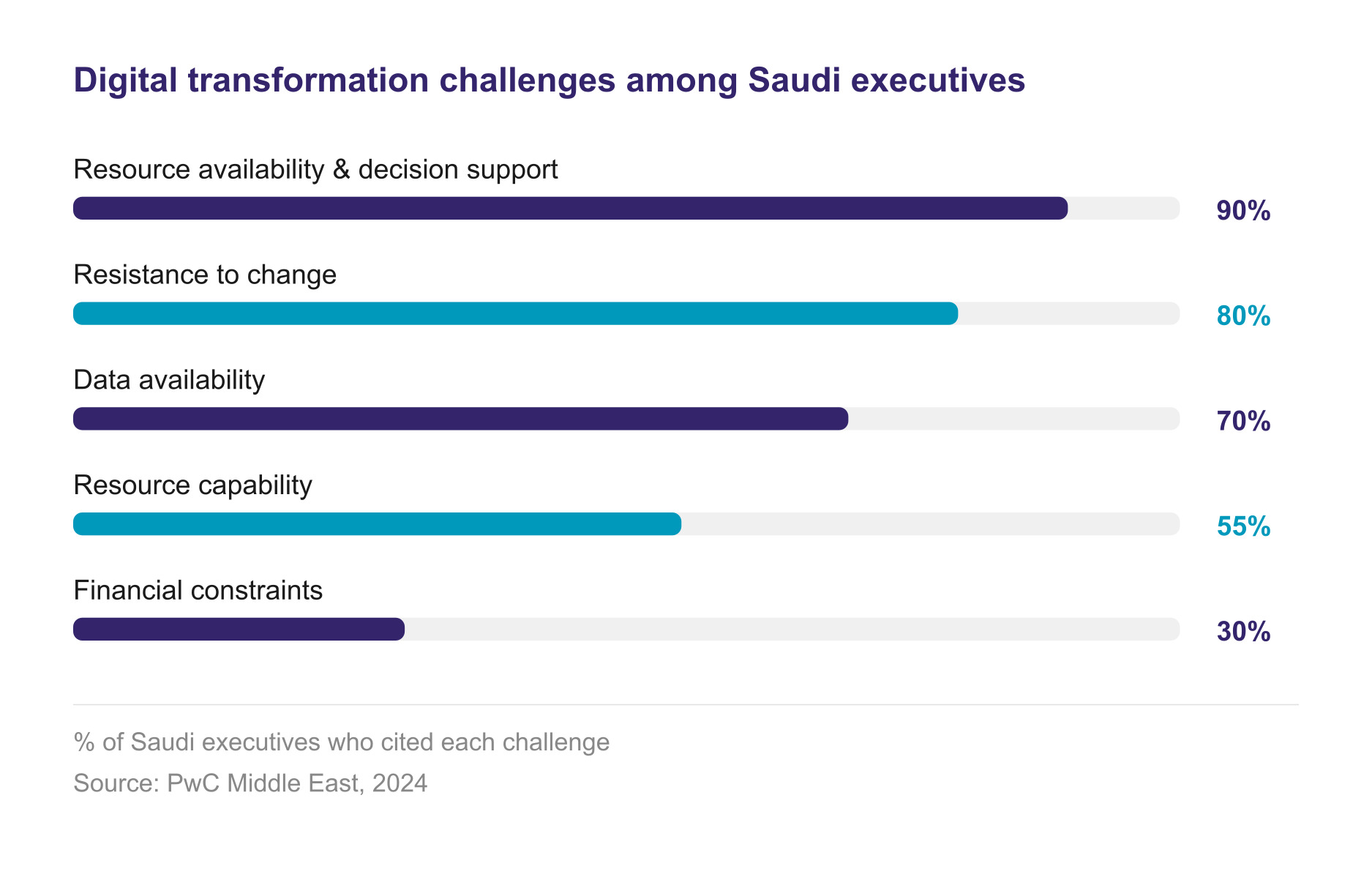
A PwC Middle East survey of Saudi executives found that 90% cited resource availability and timely decision support as their main transformation challenges.
Other reasons included: resistance to change (80%), data availability (70%), resource capability (55%), and financial constraints (30%).
Workflow automation sits inside this gap. Organizations invest in the tools but don’t know how to make them work.
A few factors make Saudi Arabia stand out:
Legacy infrastructure: Many enterprises run systems that weren't designed to connect with modern automation tools. Integration requires careful planning before deployment begins.
Workforce readiness: Automation changes roles. Without parallel investment in employee upskilling, resistance increases and adoption stalls.
Hybrid and distributed work: Approval chains, document handling, and task routing now span multiple locations. Automation that doesn't account for that creates new bottlenecks rather than removing old ones.
AI adoption challenges: Scaling your automation initiatives depends on AI readiness. Most Saudi organizations are still bridging the gap between experimentation and full deployment.
Workforce readiness: According to a Digital Government Authority (DGA) study analyzing 31 digital transformation strategies across Saudi government sectors, workforce development accounts for only 9% of digital transformation initiatives. This suggests a major gap between investing in tech and human readiness to use it. It also indicates the major resistance companies often see with their employees. Organizations need to invest in upskilling in parallel with automation deployment.
Further reading: 14 IT Infrastructure Statistics for Saudi Arabia
Where Does Workflow Automation Deliver Results in Saudi Organizations?
Four sectors are leading the adoption of workflow automation across the kingdom. These sectors can be independent or departments within the same company.
Finance and procurement
This is where most organizations start. Invoice processing, payment approvals, reconciliation, and compliance reporting are strong entry points.
In August 2023, Riyad Bank partnered with an RPA platform to automate operations, improve customer experience, and strengthen its performance culture. This marks a clear signal of financial sector commitment to automation in the Kingdom.
Government and public sector
Public entities are automating data processing, regulatory filing, and citizen-facing services.
In October 2024, the Saudi Company for Artificial Intelligence (SCAI) signed a strategic agreement with Elm to build AI-based automation solutions across government establishments, with a direct focus on improving public sector operational efficiency in line with Vision 2030.
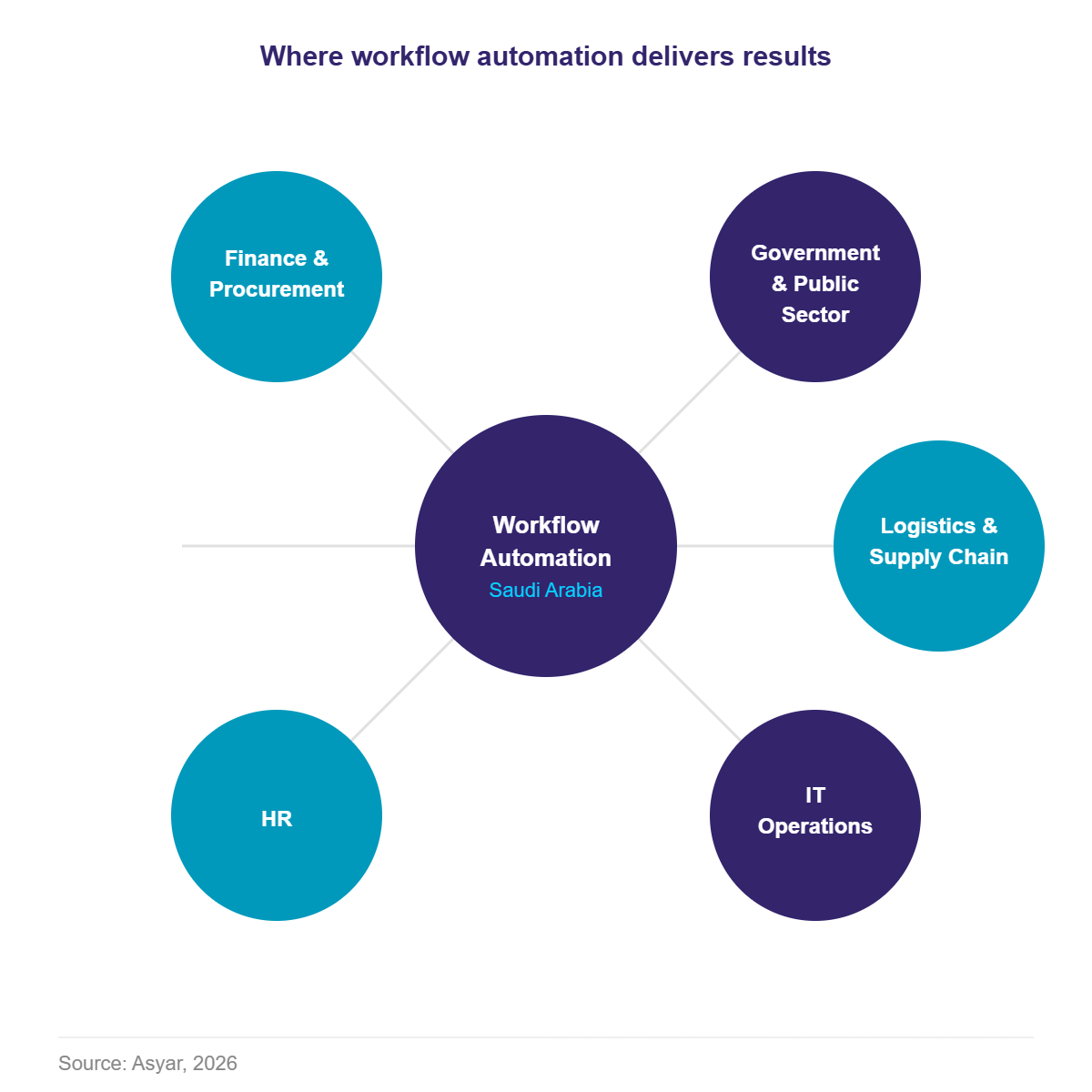
Logistics and supply chain
Automation across this sector is backed by e-commerce growth and Vision 2030 infrastructure investment. Organizations are deploying automated workflows across warehouse management, order processing, inventory tracking, and last-mile delivery coordination.
This reduces manual errors, cutting fulfillment times at scale.
HR
HR departments use automation to handle employee onboarding, document verification, and leave approvals. It allows them to process high-volume, low-complexity tasks quickly and efficiently.
IT operations
IT teams can automate incident routing, change request handling, and system monitoring alerts, freeing staff to focus on higher-value work rather than repetitive operations.
Further reading: How Do Businesses Use Artificial Intelligence in Saudi Arabia?
How to Identify Which Processes to Automate First
Not every process is worth automating. The fastest ROI comes from processes that are high-volume, rule-based, time-sensitive, and are currently being handled manually.
Before selecting a tool, run your process through these four questions. They’ll help you identify whether this process deserves workflow automation or not.
Does this process run repeatedly, like daily, weekly, or monthly?
Does it follow consistent rules with predictable inputs and outputs?
Does it involve multiple handoffs between people or systems?
Does a delay in this process result in higher costs or risks?
Processes that score high across all four are strong candidates for workflow automation.
Meanwhile, processes that require human judgment at every step are not. At least, not at this stage or until your organization's AI maturity is higher.
One prerequisite most companies skip is mapping the process before selecting a tool. Automating a broken or poorly defined process creates more problems.
A clear picture of your company’s current-state workflow acts as the foundation. Without it, automation projects underdeliver regardless of the tool in place.
Further reading: What Is IT Infrastructure for a Company in Saudi Arabia?
Make Workflow Automation Work for Your Saudi Organization
Workflow automation in Saudi Arabia is moving fast. The market data, government investment, and sector-level adoption all point in the same direction.
Organizations that hesitate risk falling behind in efficiency, cost effectiveness, and market competitiveness.
However, the companies reaping the greatest benefits are not necessarily those with the biggest budgets but those that begin with a clearly structured process, a defined objective, and an IT infrastructure designed for automation from the outset.
Asyar collaborates with Saudi enterprises to provide regulatory-compliant, modernized infrastructure and intelligent technology solutions, turning automation into a core advantage for your digital transformation journey.
Book your free consultation with Asyar today.