
How to Reduce IT Technical Debt in Saudi Organizations
IT technical debt in Saudi Arabia blocks modernization and AI plans. Learn how to measure what you carry, then book an assessment to start reducing it.
Asyar-team

Somewhere in your organization is a system nobody wants to touch. The person who built it has left. Vendor support lapsed years ago. Your team has built workarounds around it, and those workarounds now have workarounds of their own. Nobody can say exactly what breaks if you switch it off, so it stays.
KPMG found 66% of organizations in Saudi Arabia say flaws in their foundational IT systems disrupt day-to-day operations every week. That is the working reality of IT technical debt. Each disruption is small enough to absorb. None is large enough to force a decision.
The cost doesn't appear on any report. It sits inside support contracts, overtime, and incident response. It also shows up as a premium on every new project that has to integrate with an aging system. McKinsey puts that premium at an extra 10% to 20% of project cost.
So the request to fix the foundation arrives without a number. It loses to work that has one.
In this article, we'll explain what IT technical debt is and why Saudi organizations have more of it than most leaders realize. We'll also cover how to measure what you have and where to start reducing it.
What Is IT Technical Debt?
IT technical debt is the accumulated cost of shortcuts, outdated systems, and deferred upgrades. It builds when speed or budget pressure takes priority over the health of your IT infrastructure.
Like financial debt, IT technical debt has a principal and interest. The principal is what it would cost to put your systems right. The interest is what you pay every year you don't. It appears as higher support costs, slower delivery, and staff time lost to maintenance.
Not every old system counts though. A 10-year-old platform that is supported, documented, and doing its job is just an old platform. It becomes debt when keeping it running becomes costly, or when it stops you from adopting something better.
Some debt is deliberate. A team ships fast and plans to fix things properly later. Other debt builds without anyone choosing it. Upgrades get postponed one cycle at a time, until nobody remembers the system well enough to touch it.
The banking and financial sector often struggles most with legacy IT. Core systems built decades ago still clear every transaction. Each new product becomes another layer on top. Years later, one small change has to be tested across all of them.
In Saudi organizations, technical debt often looks like a government agency running a decade-old ERP platform. Or an enterprise relying on legacy systems that were never updated after initial deployment.
Why Are Saudi Organizations Exposed to IT Debt?
Saudi organizations have been modernizing at speed with major investments consistently poured into the IT sector. What often goes unchecked is the state of the foundations.
Government spending on ICT services passed SAR 31.9 billion in 2025. Cloud spending rose 42% year on year, and AI and emerging technology grew 20%. Vision 2030 targets have made that pace the baseline rather than the exception.
However, it’s what drives these decisions that matters. KPMG found Saudi technology investment is guided most by third-party advice, including regulators, at 99%.
In-house trials follow at 83%, and competitor adoption at 77%. Cost effectiveness ranks last, at 26%.
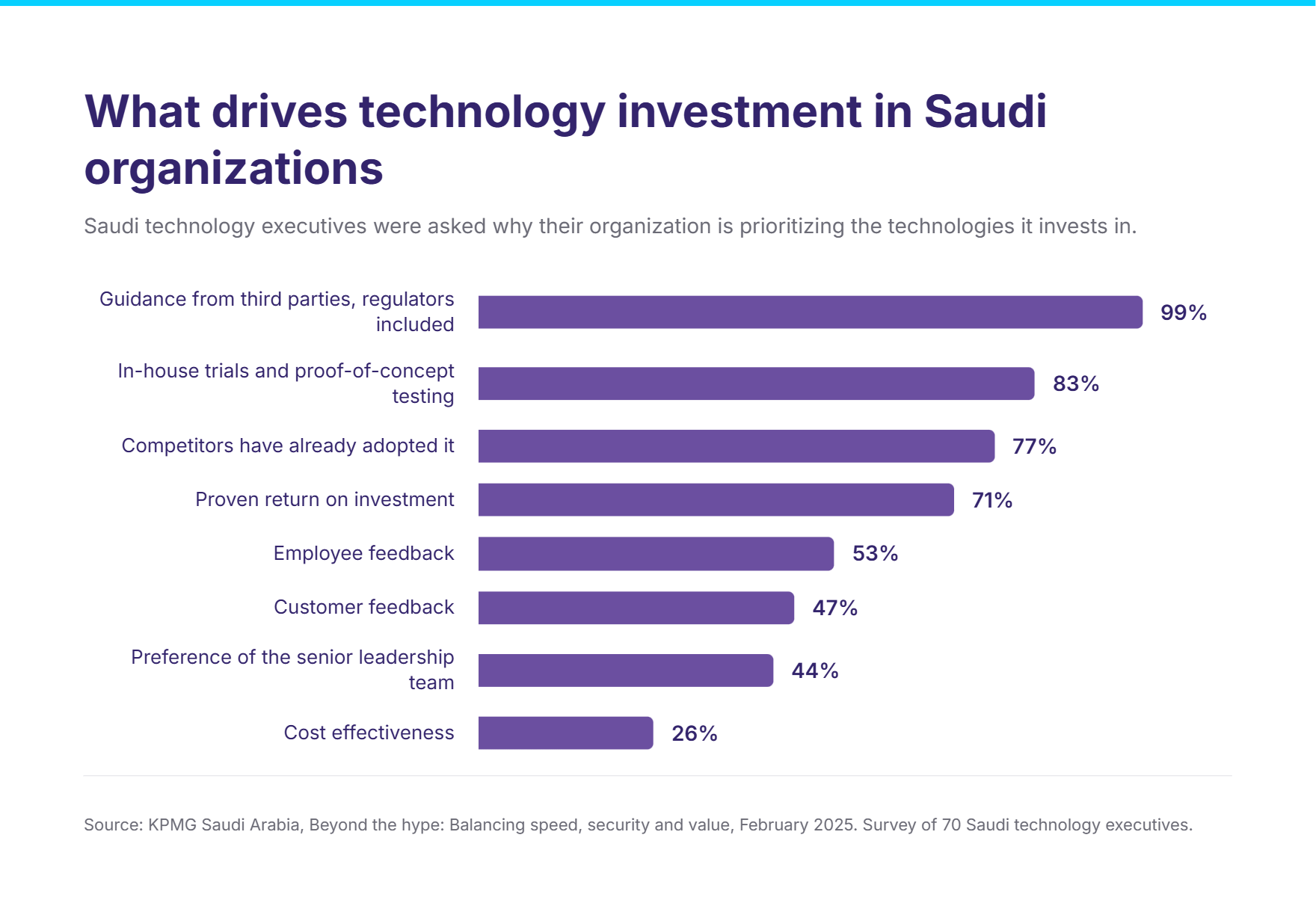
Each of those drivers looks outward or forward. None asks what the existing systems can hold. Only 24% of Saudi leaders evaluate their technology portfolio against long-term goals. That leaves three in four adding to infrastructure they don’t systematically review.
Then the decisions stall. 93% of Saudi executives say a risk-averse attitude makes senior leadership slower to respond than competitors. Replacing a core system is exactly the kind of decision that attitude defers.
Each new layer makes the next one harder to remove. That is how a well-funded IT infrastructure ends up expensive to run and slow to change.
How Do You Know How Much Technical Debt You Have?
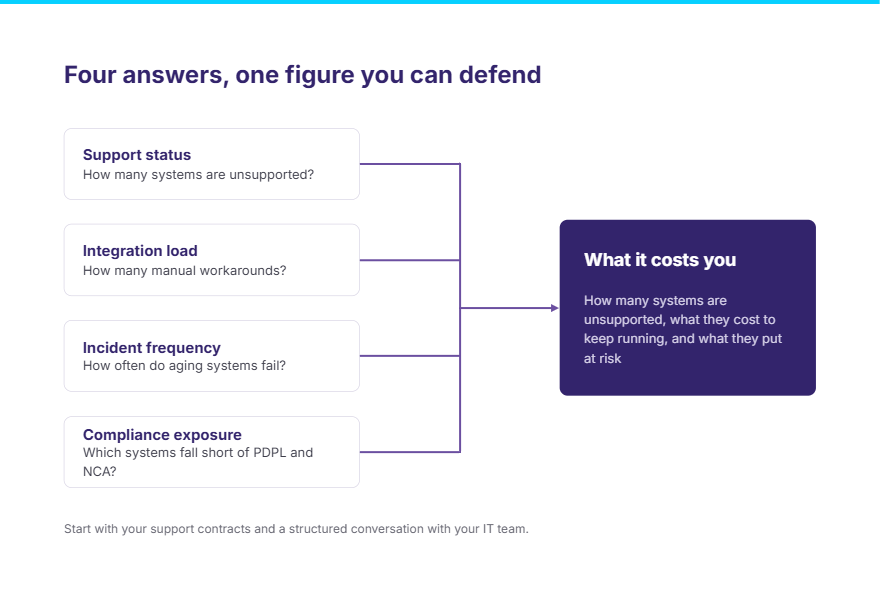
You don't need a formal assessment or an outside audit to start. The following four questions will help you figure out how much IT debt you have. Each one gives you a number not an impression or gut feeling.
Support status: How many core systems are past vendor support or running unpatched versions?
Integration load: How many manual workarounds does your team maintain to keep systems talking to each other?
Incident frequency: How often do aging systems cause downtime, delays, or failed month-end processes?
Compliance exposure: Which systems fall short of Personal Data Protection Law (PDPL) and National Cybersecurity Authority (NCA) requirements?
Start with your support contracts and a structured conversation with your IT team. Rough answers should take about a week. You don’t need an exact number, a range works fine and still gives you an estimate.
You can now say how many systems are unsupported, what they cost to keep running, and what they put at risk. That is a version of the problem your CFO can work with.
McKinsey found that organizations actively managing their technical debt free engineers to spend as much as 50% more of their time on work that supports business goals.
Further reading: How to Measure Digital Transformation ROI
A Practical Framework for Reducing IT Technical Debt
You will not clear your technical debt in a month or single budget cycle. Realistically, you need to stop it from growing and identify what is costing you most. Trying to replace everything at once usually fails.
McKinsey compared organizations with the most IT technical debt against those with the least. The first group was 40% more likely to leave a modernization unfinished or cancel it outright.
Here’s a three-step approach:
Categorize by risk and cost: Separate what's business-critical from what's simply old. Your audit gives you the raw list. This step sorts it into what needs replacing, what needs upgrading, and what can be left alone.
Put compliance exposure first: Anything that creates exposure under PDPL or NCA moves to the top. That debt comes with a deadline somebody else sets.
Make it a standing budget line: Debt work that needs special approval each year will keep losing to initiatives with visible output. McKinsey found that organizations which modernize deliberately keep run costs at least 20% lower than those that don't.
One practical move: Attach debt reduction to programs that already have funding. A stand-alone modernization budget is hard to win. Fixing the foundations underneath a funded initiative is easier to approve, and it’s often the same work.
Further reading: Don’t Start Building IT Infrastructure from Scratch Until You Read This
How Does IT Technical Debt Affect Your AI Plans?
Any conversation about technical debt now ends up at AI. That is true in Saudi Arabia and everywhere else, because AI is where the budget, the board's attention, and the pressure to show results currently sit. AI also makes technical debt more expensive, in two ways.
The first is operational. AI needs systems that can share data cleanly. Systems held together by manual workarounds supply neither the integration nor the data quality that AI tools assume.
Those layers of workarounds are where it breaks down. Each one is a place where data changes shape or stops moving.
The second is financial. McKinsey found AI now consumes up to a third of companies’ change budgets. This is the same budget modernization competes for, so the money for fixing foundations gets squeezed as AI spending rises.
This is why reducing technical debt belongs in the base budget rather than in an annual request. It will lose to an AI initiative every time.
The four audit questions do double duty here. The systems that are unsupported, poorly integrated, and failing most often are usually the same ones blocking your AI plans.
KPMG found almost 40% of Saudi organizations already generating value from AI. The ones that scale it will be the ones whose systems can carry it.
Further reading: AI Adoption Challenges in Saudi Arabia: What Businesses Need to Know
Start With What You Can Measure
Technical debt doesn’t announce itself. It builds quietly, one deferred upgrade and one workaround at a time.
It also never arrives as a decision. Nobody approves it, so nobody is held to fixing it. For Saudi organizations under pressure to transform, the greater risk is building on a foundation that can’t hold the weight.
If you can’t name the number today, that is the first problem to solve. Four questions, a week, and an honest conversation with your IT team will produce a figure. Take that figure into your next budget discussion.
Asyar has worked on IT infrastructure in Saudi Arabia for more than 20 years. That includes the aging systems most organizations would rather leave alone.
Organizations working with Asyar have seen up to 25% less downtime and 20% to 30% lower costs.