
Legacy System Modernization in Saudi Arabia: Costs & Next Steps
Legacy system modernization is now a business decision, not just an IT one. Here's what it costs Saudi organizations to wait, and where to start.
Asyar-team

Somewhere in your infrastructure is a system that only one or two people fully understand. Nobody calls it a legacy system. It's just what you've always used. It has survived several budget approvals already, each one renewing it by default. Before you sign off on another year, you need a number for what it costs you now.
That number is harder to find than it should be. Nearly 80% of US federal IT spending in 2025 was planned for running existing systems, not building new ones.
In Saudi Arabia, over 60% of financial institutions offering financing products still run on legacy systems. Legacy system modernization keeps slipping because its cost never arrives as a single invoice.
In this article, we’ll break down what the delay in modernizing your legacy systems costs you, and where to start without disrupting operations.
What Is Legacy System Modernization?
Legacy system modernization means updating, replacing, or restructuring systems that no longer meet your current needs.
Those needs may be commercial, security, HR, compliance, or something else. Legacy systems can sit in any part of your organization.
What most businesses and leaders don't realize is that legacy system modernization is rarely a complete rebuild. Often, it happens in phases with parts of the system replaced over time while operations continue.
The harder question is which systems qualify. Age alone is a poor test. A system becomes legacy when the cost and risk of keeping it outweigh the cost of changing it.
In most cases the system did not get worse. The requirements around it changed. A 15-year-old system that runs cheaply and passes audit is not your priority. On the other hand, a five-year-old system with rising costs and compliance gaps might be.
This is why so many go unexamined. Nobody files them under "legacy." They sit in the budget as a renewal line nobody questions.
A 2025 US government audit singled out 11 critical federal systems. They ranged from 23 to 60 years old, and eight still ran on outdated programming languages.
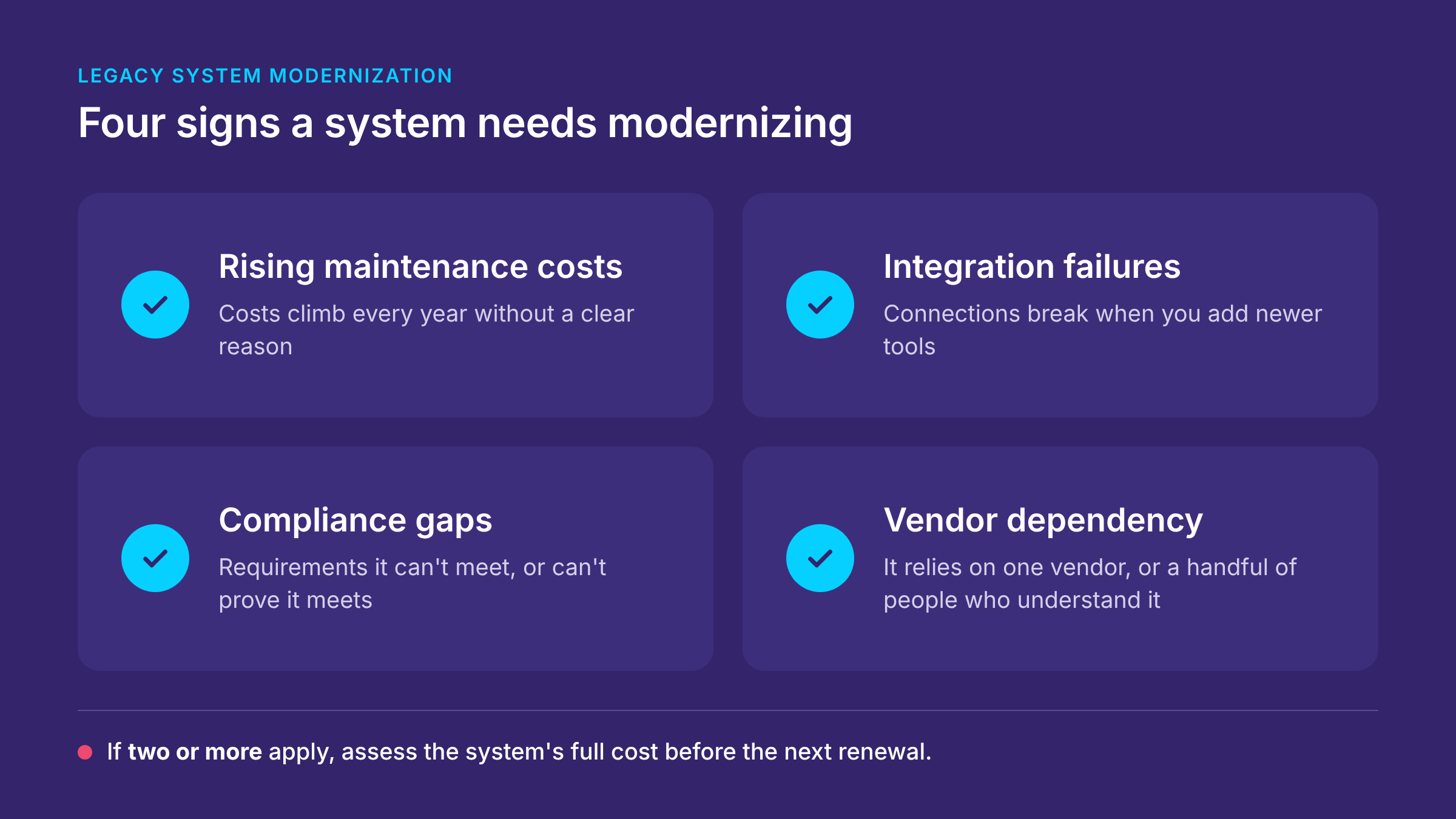
Four signs tend to appear together:
Maintenance costs that rise each year without a clear reason
Integration failures when you connect the system to newer tools
Compliance requirements the system can’t meet, or can’t prove it meets
Dependence on one vendor, or on a handful of people who understand it
If two or more apply, it’s worth evaluating the system and assessing its full cost before the next renewal.
What Does Legacy IT Cost Saudi Organizations?
Legacy IT costs rarely show up as a single line item. They're spread across your budget, your timelines, and your risk register.
That's what makes a legacy system easy to renew and hard to question.
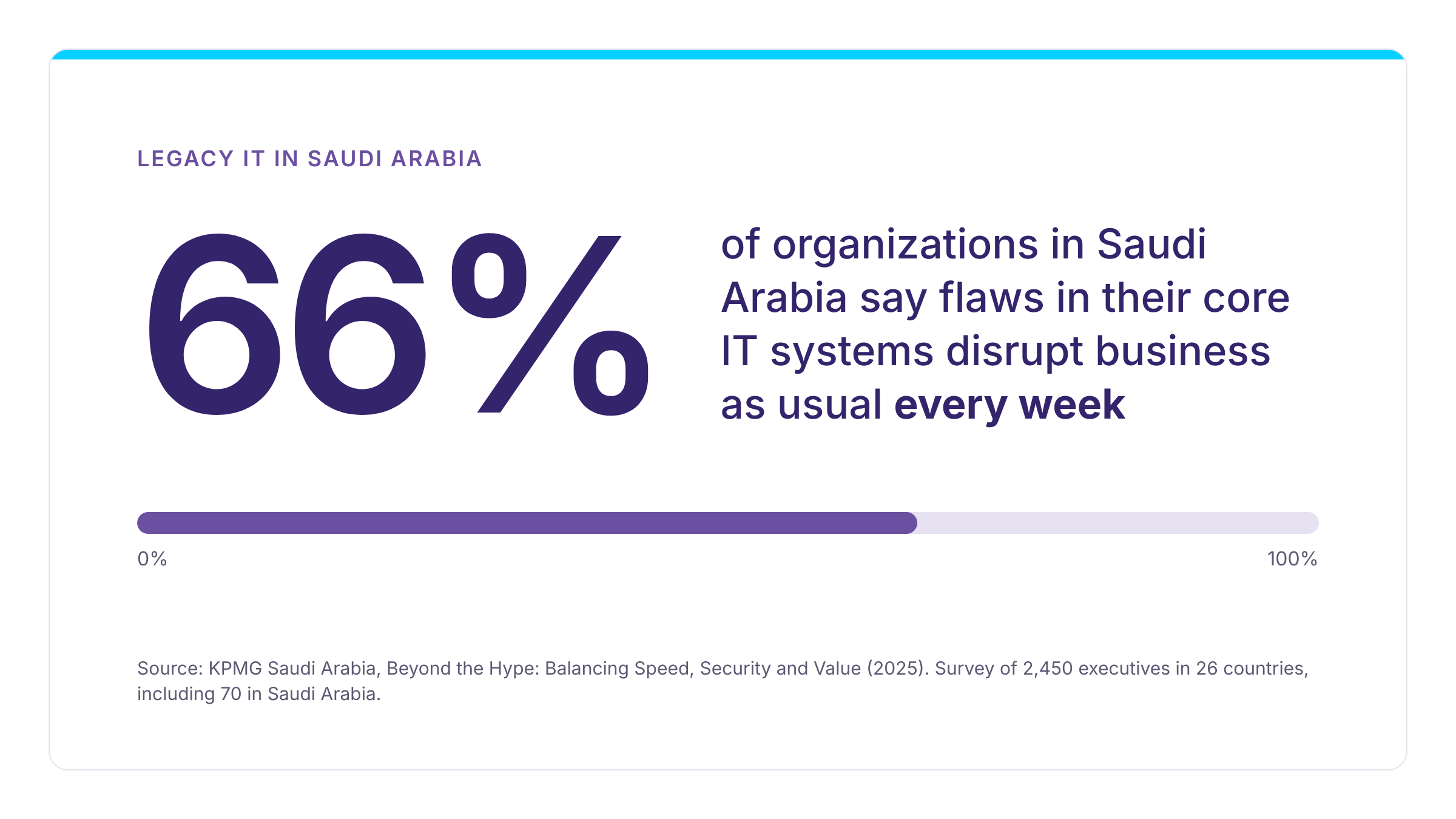
The disruption is also more frequent than most leaders assume. In Saudi Arabia, 66% of organizations say flaws in their core IT systems disrupt business as usual every week, according to KPMG.
Most of the cost falls into five areas.
Maintenance that takes up the place of new work
An aging system needs patches, workarounds, and specialist support every year. That money comes from the same budget as new projects.
A 2025 US government audit found that legacy systems cost more to operate and maintain over time, not less. Each year, the share left for new capability gets smaller.
Slower launches and missed opportunities
Anything new that has to connect to an old system takes longer to build. This is clearer in the banking sector, compared to others, since it’s where many legacy systems reside.
Globally, over 70% of banks still rely on decades-old core systems. Banks with disconnected systems take up to three times longer to launch new products, according to Deloitte.
The effect is already visible in the Gulf Cooperation Council (GCC). Over half of financial institutions in Saudi Arabia and the UAE say their current technology has cost them business opportunities.
The same pattern holds wherever a new service depends on an old system.
AI pilots that never scale
Saudi Arabia named 2026 its Year of AI, which raised expectations for results across the public and private sectors.
Yet many AI projects stall after the pilot stage. Globally, KPMG found that only one in three organizations had achieved AI value at scale.
The blocker is often the data, and that data usually sits in legacy systems. A pilot can run on a sample or a copy of the data.
Scaling it means connecting AI to the systems where your data lives. Older systems tend to keep data in silos, in formats that don’t connect easily.
Nearly 80% of banking executives say data fragmentation is the main barrier to scaling AI.
For many organizations, the first AI investment that pays off is the one that fixes the data underneath.
Further reading: AI Adoption Challenges in Saudi Arabia: What Businesses Need to Know
Compliance that costs more to maintain
Saudi regulations set clear expectations for data residency, access control, and audit trails. These include the National Cybersecurity Authority's (NCA) Essential Cybersecurity Controls and the Personal Data Protection Law (PDPL).
Many older systems were built before these rules existed. Keeping them compliant usually means workarounds: manual reports, extra tools, or outside specialists. Each one adds cost every year.
Dependence on a few people or one vendor
When only one or two people understand a system, every resignation or extended leave becomes an operational risk.
Vendor dependence works the same way. More than 87% of financial institutions in Saudi Arabia rely on external vendor platforms.
When one vendor controls the platform, every renewal becomes their negotiation, not yours. Neither cost appears on an invoice until something goes wrong.
Before you compare these costs with the cost of modernization, you need to be clear about what you're replacing.
Sometimes the problem is one application. Sometimes it's the entire IT infrastructure underneath it: the servers, databases, and workflows it depends on. The two carry very different costs and timelines.
Further reading: 14 IT Infrastructure Statistics for Saudi Arabia: Global & Regional Benchmarks
How Can You Modernize Legacy Systems Without Disrupting Operations?
Many Saudi organizations have already decided to act. Roughly 84% of Saudi financial institutions plan to modernize their technology within 12 months.
But deciding is the easy part. Implementing a decision, including creating a digital transformation strategy to modernize your legacy systems without putting operations at risk is much harder.
Caution slows many leaders down. According to KPMG, 93% of executives in Saudi Arabia say a risk-averse attitude makes senior leadership respond slower than competitors.
That caution makes sense when the plan is to replace everything in a single cutover. A phased plan carries far less risk, and it starts smaller than most expect.
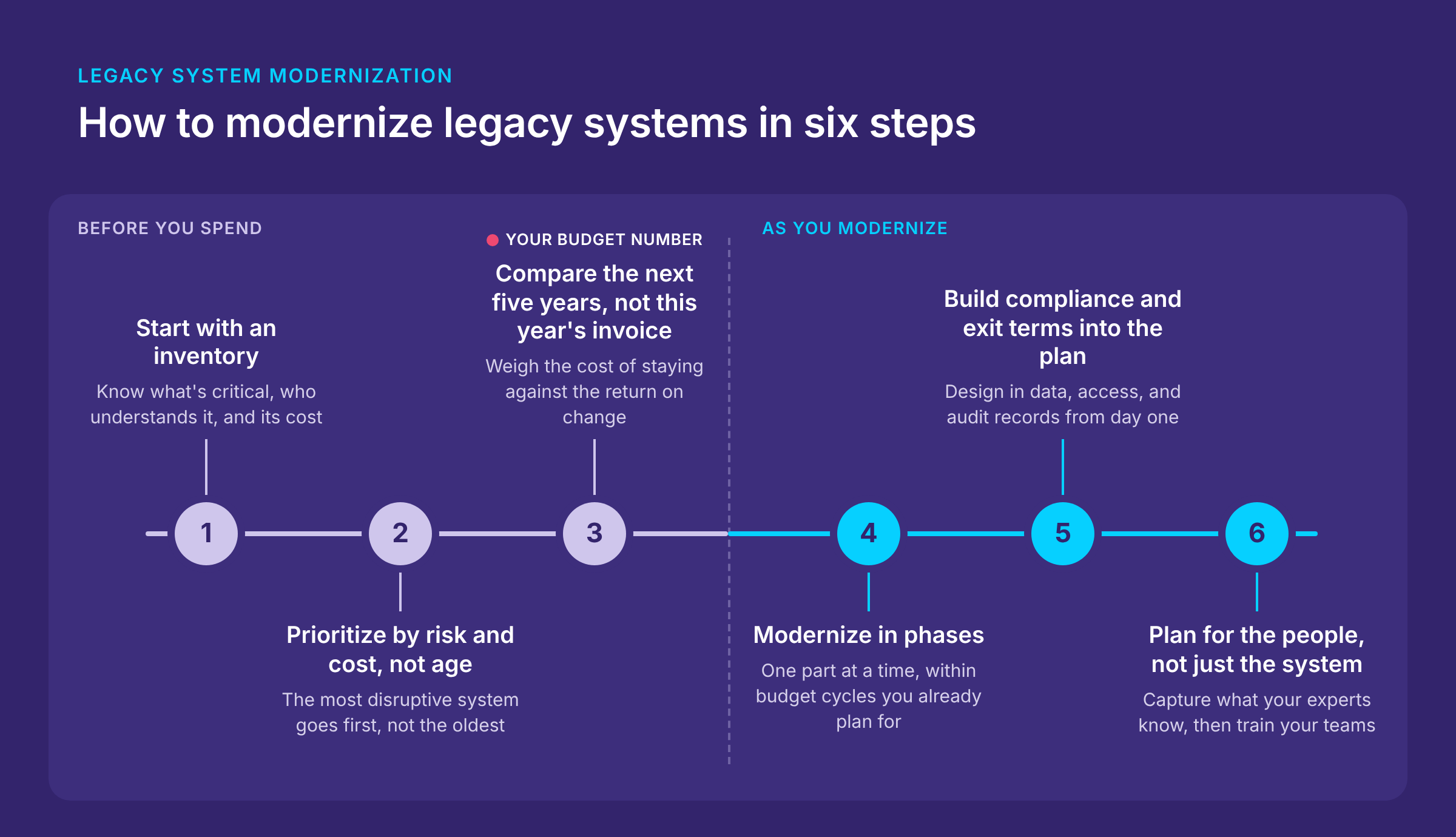
Here’s how to execute a phased legacy system modernization plan:
Start with an inventory
List which systems are business-critical and which are simply old. For each one, note who understands it, what depends on it, and what it costs to run.
Note, too, whether the problem is the application itself or the infrastructure underneath it. Few organizations do this regularly.
Only 24% of leaders in the Kingdom are strategically evaluating their tech investment portfolio, according to the KPMG survey. The real risk often sits in a few systems, not everywhere.
Prioritize by risk and cost, not age
Rank systems by business impact, compliance exposure, dependence on scarce skills, and how much of your core data they hold.
The oldest system is not always the first one you need to replace. The one causing the most disruption, cost, or audit risk is the one to start with.
Compare the next five years, not this year's invoice
Renewing an old system almost always looks cheaper than replacing it, if you only look at one year.
But what you really need to do is compare the full cost of keeping this legacy system over a three-to-five-year period and see the real cost of not modernizing it.
Include maintenance, downtime, compliance work, and specialist support. Then weigh the return.
KPMG reports that 53% of Saudi respondents saw profit uplifts of at least 11% from digital transformation.
That comparison is the number your budget review needs, built the same way you would measure digital transformation ROI.
Modernize in phases
Upgrade or replace one part at a time, tied to budget cycles you already plan for.
Old and new systems often run side by side for a period. This keeps operations running and spreads both cost and risk. It also gives you early results to show before you commit to the next phase.
Further reading: 31 Digital Transformation Statistics for Saudi Arabia
Build compliance and exit terms into the plan
Keeping data in the Kingdom, controlling who can access it, and recording that access are easier to design in from the start.
Retrofitting them later, once a system is live, costs more. Agree on exit terms with any new vendor too, so you don't recreate the same dependency.
Plan for the people, not just the system
The one or two people who understand the old system hold knowledge you'll need. Document what they know before the transition starts, not after.
Then train the teams who will use and run the new system. IT modernization only pays off when people adopt it.
Further reading: Don't Start Building IT Infrastructure From Scratch Until You Read This
Modernize Your Legacy Systems One at a Time
Every legacy system in your organization was once the right decision.
The question is whether it still serves your business, your compliance obligations, and the people who rely on it, today and in the coming years.
You don’t need to answer that for every system at once. A phased approach lets you fix the highest-risk system first, show results, and build from there.
The upside goes beyond savings. Almost 40% of organizations in Saudi Arabia were already generating value from AI. Scaling that value depends on systems that can share data.
Asyar’s leadership brings more than 20 years of experience in the Saudi market. The team has delivered more than 35 transformation projects and is 100% PDPL and NCA compliant.
Clients have seen up to a 25% reduction in downtime and 20% to 30% lower costs.
Start with the one system only one or two people understand. Assess its full cost and risk before it comes up for renewal again.
Book a call with Asyar for a legacy system modernization assessment.
Legacy System Modernization in Saudi Arabia: Costs & Next Steps
Asyar-team